Chinese


SZE among Central and Eastern Europe’s top 100 universities in THE regional ranking
Széchenyi István University ranks 83rd in the first Central and Eastern Europe Spotlight published by Times Higher Education (THE), featuring higher education institutions from 12 countries. The regional list is based on the organisation’s 2027 World University Rankings, in which the University in Győr moved up 210 places in one year.
Times Higher Education (THE), one of the world’s most respected higher education ranking organisations, has produced a separate comparison of institutions in Central and Eastern Europe for the first time this year, based on its 2027 World University Rankings. Published on 17 November, the ranking assesses the performance of universities in 12 countries: Hungary, Bulgaria, Croatia, the Czech Republic, Estonia, Lithuania, Latvia, Poland, Romania, Slovakia, Slovenia and Ukraine. The results were presented at the LUMEN 2026 international higher education conference, held in Kraków on 17–18 November. The regional comparison provides a more detailed picture of how institutions in the region perform in relation to one another than the global rankings.
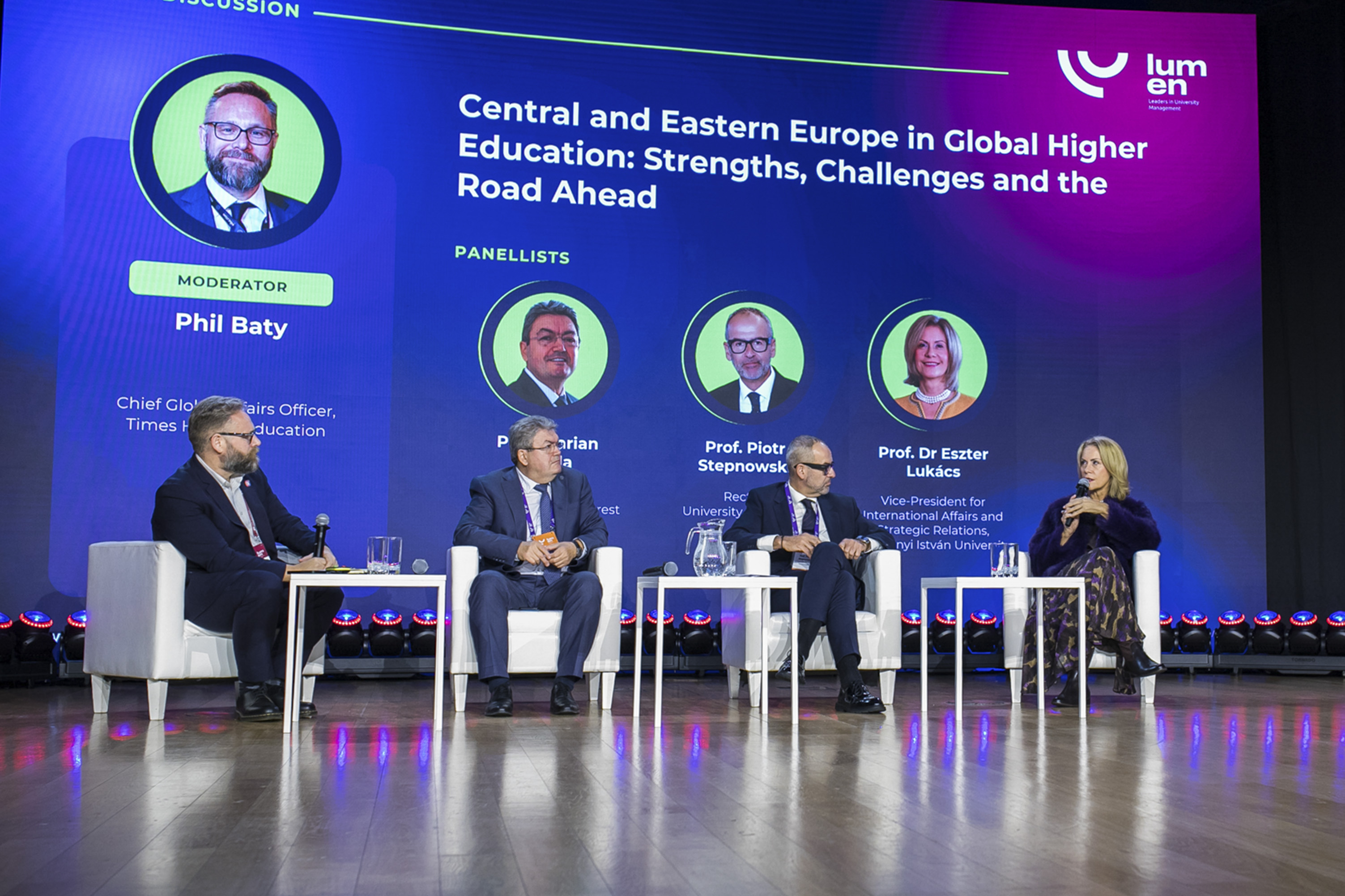
The results of THE’s Central and Eastern Europe Spotlight were announced at the LUMEN 2026 conference in Kraków. Participants in one of the conference’s panel discussions: Phil Baty, Chief Global Affairs Officer at THE; Professor Dr Marian Preda, Rector of the University of Bucharest; Professor Dr Piotr Stepnowski, Rector of the University of Gdańsk; and Professor Dr Eszter Lukács, Vice-President for International Affairs and Strategic Relations at Széchenyi István University. (Photo: LUMEN 2026)
Semmelweis University in Budapest topped the list, followed by the University of Tartu in Estonia and Charles University in the Czech Republic. Wroclaw Medical University in Poland
came fourth, while another Polish institution, Jagiellonian University, took fifth place. A total of 13 Hungarian universities were included in the ranking, with Széchenyi István University securing 83rd place and thus ranking among the region’s top 100 higher education institutions. In THE’s previously published World University Rankings, the Univesity in Győr moved up from 1,835th place last year to 1,625th, representing the greatest improvement among Hungarian universities. This THE ranking evaluates higher education institutions using 17 indicators covering the teaching environment, research performance, knowledge transfer and international outlook.
Professor Dr Eszter Lukács, Vice-President for International Affairs and Strategic Relations at Széchenyi István University, participated in two expert panel discussions at the LUMEN 2026 conference, where the regional ranking was announced. The first discussion, moderated by Phil Baty, Chief Global Affairs Officer at THE, explored the international standing of higher education in Central and Eastern Europe, as well as the strengths and competitiveness of institutions in the region. Later, the panel entitled “Climbing with Purpose: Strategy, Policy and Position in a Competitive CEE Landscape” focused on the long-term objectives of higher education strategies, the relationship between national policies and university autonomy, and opportunities for regional cooperation.

Participants in the panel discussion on competitive higher education strategies: Professor Dr Łukasz Sułkowski, President of the Management Board of PCG Polska, a consulting firm; Inga Bratēna, Chief Operating Officer of Riga Technical University; Professor Dr Jarosław Górniak, Vice Rector for International Cooperation, Jagiellonian University in Kraków; Professor Dr Eszter Lukács, Vice-President for International Affairs and Strategic Relations at Széchenyi István University; and Chris Tagg, Director of Consultancy Services for the UK and Europe at THE. (Photo: LUMEN 2026)
According to Professor Dr Eszter Lukács, the new regional analysis provides an opportunity to compare the University’s performance with that of geographically close institutions sharing similar development characteristics. “Our place among the top 100 institutions in Central and Eastern Europe, together with the significant progress we have made in the world rankings, provides us with valuable feedback,” she said. “Our aim remains to strengthen our research excellence, international relations and corporate partnerships, which will continue to shape our competitiveness in the long term.”
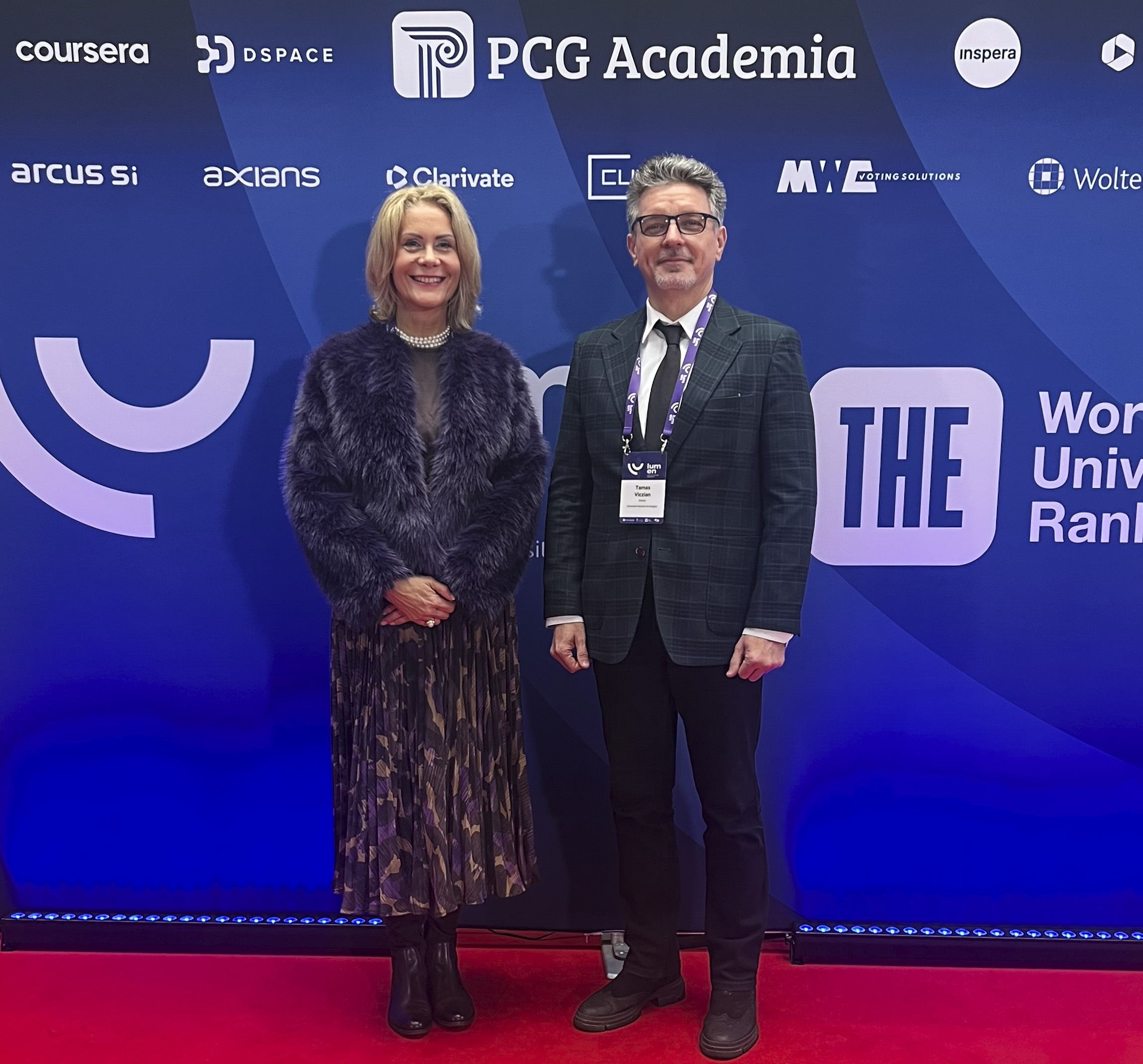
At the conference in Kraków, Professor Dr Eszter Lukács also met Tamás Viczián, Foreign Economic Attaché at the Consulate General of Hungary in Kraków.