 Chinese


Horizon Europe: National Research, Development and Innovation Office Holds Information Day at SZE
The National Research, Development and Innovation Office recently delivered a series of informative presentations for lecturers and researchers at Széchenyi István University on the European Union’s Horizon Europe calls. During the information day, staff of the Office’s National Contact Point provided useful insights into the application process and the details of conducting research within consortia.
To promote the Horizon Europe programme, a network of National Contact Points has been established in every EU Member State – including Hungary – playing a key role in supporting the success of applications in each country. In Hungary, the group operating under the National Research, Development and Innovation Office (NKFIH) is responsible for providing high-quality, free-of-charge support to potential applicants, including research institutes, universities, companies, non-profit organisations and individual researchers.
The Office’s staff recently visited Széchenyi István University to offer lecturers and researchers the opportunity to gain a more in-depth understanding of the application system through an information day and one-to-one consultations. The event was organised by the University’s Directorate for Grants, which has been supporting staff for nearly twenty years in identifying funding opportunities, preparing successful applications and ensuring effective project implementation. The unit currently coordinates around 140 ongoing projects with a total value of nearly HUF 30 billion.
“The University is a key partner of the NKFIH, and thirty per cent of our applications are linked to schemes managed by them,” stated Nóra Mészáros, Head of the Directorate of Projects. She added that a quarter of the currently running projects are implemented within international collaborations, fourteen of which fall under the Horizon Europe framework. She also noted that the University’s projects cover a wide range of professional fields, including agricultural digitalisation, sustainable mobility, the development of alternative fuels, and the protection of freshwater ecosystems.
At the opening of the programme, Dr Péter Németh, Scientific Secretary of the University, emphasised that building international research networks is of strategic importance for the institution, as is publishing the results of such collaborations in prestigious, internationally recognised, Scopus-indexed journals. “These publication outcomes, the utilisation of intellectual outputs, and the revenues from grants directly contribute to the sustainable operation of our University and to our position in international higher education rankings,” he explained.
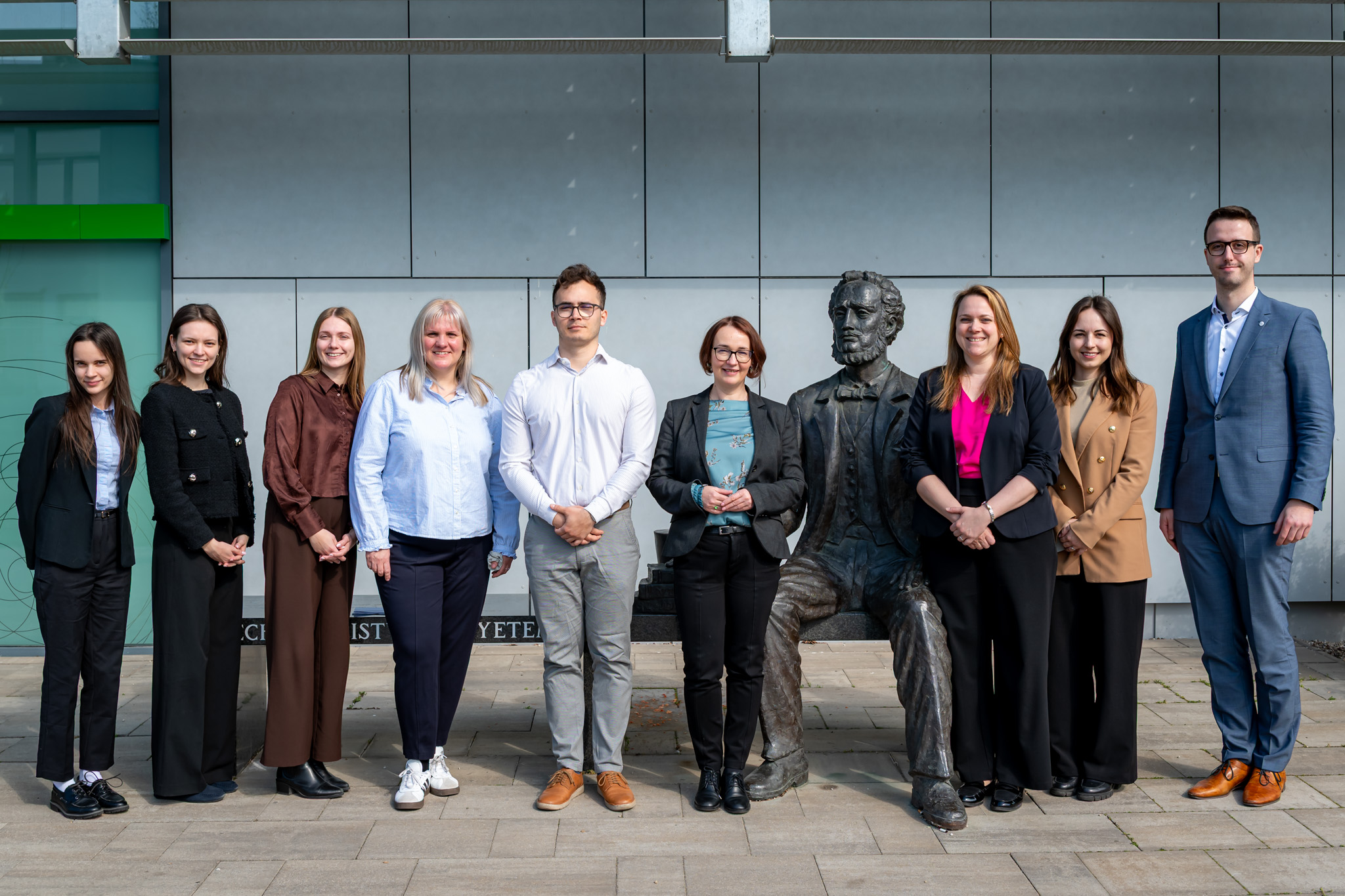
Staff of the International Cooperation Department of the NKFI and representatives of Széchenyi István University at the event (Photo: András Adorján)
During the briefing, Dr Borbála Schenk, Head of the NKFIH’s International Cooperation Department, provided an overview of the Horizon Europe programme. “Currently, more than seven hundred calls are available, covering areas from health and autonomous vehicles to agricultural innovation. There are therefore numerous fields in which targeted calls are open and available for application,” she noted. She drew attention to the fact that participation in major international consortia requires broad visibility and active engagement with researchers from other countries. She encouraged those interested to take advantage of the support opportunities offered by the Office, to build their international partner networks, and to apply with confidence for calls that align with their professional activities.
During the presentations, the NKFIH’s National Contact Points outlined the thematic areas available for application based on the structure of the Horizon Europe programme, namely the six clusters that define its calls. Zsuzsanna Kürti presented health; Dóra Pivarcsiné Fekete, Head of Department, covered culture, creativity and inclusive society; Máté Schultheisz and Flóra Csesznok discussed civil security, as well as digitalisation, industry and space; Barbara Kiss presented energy, mobility and climate; while Noémi Genzler introduced opportunities related to food, bioeconomy, natural resources, agriculture and the environment. The EU’s “New European Bauhaus” architectural initiative was also discussed, which supports developments that are beautiful, sustainable and inclusive. In the second half of the information day, participants had the opportunity to take part in individual consultations.