Chinese


Hungarian Brothers at Robotics: SZE Team Wins Bronze at European Robotics Championship
András Erdélyi and Balázs Erdélyi, competing as the BITS team, achieved the best result among the Hungarian entries, finishing third at the World Robot Olympiad (WRO) European Championship in Zagreb. The competition brought together 216 teams from 46 countries. The two brothers competed in the Future Engineers category and are both enrolled in Széchenyi István University’s Robotics and Programming micro-credential programme. Balázs is also a first-year vehicle engineering student at the University. Their coach, Norbert Boros, is a member of the University’s staff.
Széchenyi István University places great emphasis on robotics education and nurturing the talents of young people with an interest in engineering and technology. From the age of nine, the University offers opportunities to learn how to build and programme robots, and regularly prepares participants for national and international competitions. This year, the Apáczai Csere János Faculty of Education, Humanities and Social Sciences hosted the regional round of the FIRST LEGO League competition, while the University's central campus was the venue for the Hungarian national final of the World Robot Olympiad (WRO).
The University’s robotics education programme in Győr recently achieved a significant success: at the WRO European Championship in Zagreb, the team comprising András Erdélyi and Balázs Erdélyi achieved the best result among the Hungarian entries. Competing as BITS in the Future Engineers category, the duo took third place, securing a position among the leading teams on the international stage. The competitors had to complete a series of challenges using a self-developed autonomous robotic vehicle, including obstacle avoidance and parking. Some of the equipment needed to build the robot, including the camera, was provided by the Autonomous and Intelligent Robots Laboratory at Széchenyi István University’s Automotive Industry Research Centre. What makes the brothers’ achievement even more impressive is that they scored the maximum number of points available on the course, with the final podium positions ultimately determined solely by the assessment of the technical documentation. Two German teams finished ahead of the Hungarian duo.
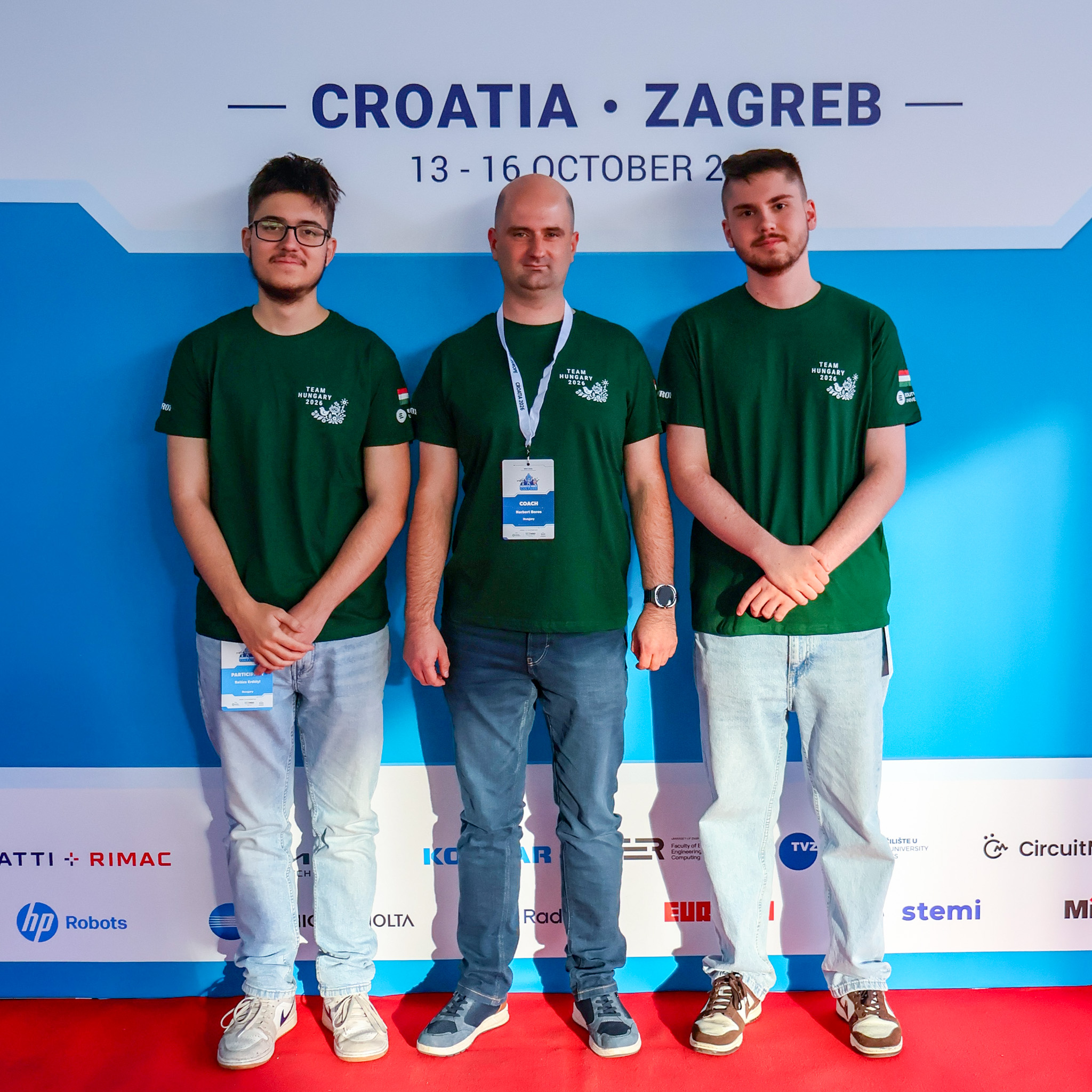
The Hungarian team that secured a place on the podium: Balázs Erdélyi, coach Norbert Boros and András Erdélyi. (Photo: Zoltán Erdélyi)
The competition in Croatia brought together 216 teams from 46 countries. Hungary was represented by 13 teams comprising a total of 34 students in the RoboMission, Future Innovators, Future Engineers and RoboSports categories. The young competitors from Győr were the only Hungarian team to secure a place on the podium.
“We went into the competition hoping that, in such a strong field, we might finish somewhere around sixth place and would already have been very happy with that. In the end, everything went according to plan. It was a great feeling to see that we are capable of putting in such a performance on the international stage as well,” said Balázs Erdélyi. The first-year vehicle engineering student at Széchenyi István University explained that he and his older brother, who is studying for an MSc in Artificial Intelligence Informatics at Eötvös Loránd University in Budapest, have been interested in robotics since childhood. He himself has been taking part in the robotics sessions for almost ten years. He also revealed that he has already joined the Arrabona Racing Team, which competes in the Formula Student series, at the University, giving him the opportunity to gain further experience in vehicle development alongside his studies. He added that one of the highlights of the event in Zagreb was meeting young people from different countries around the world who shared his interests.
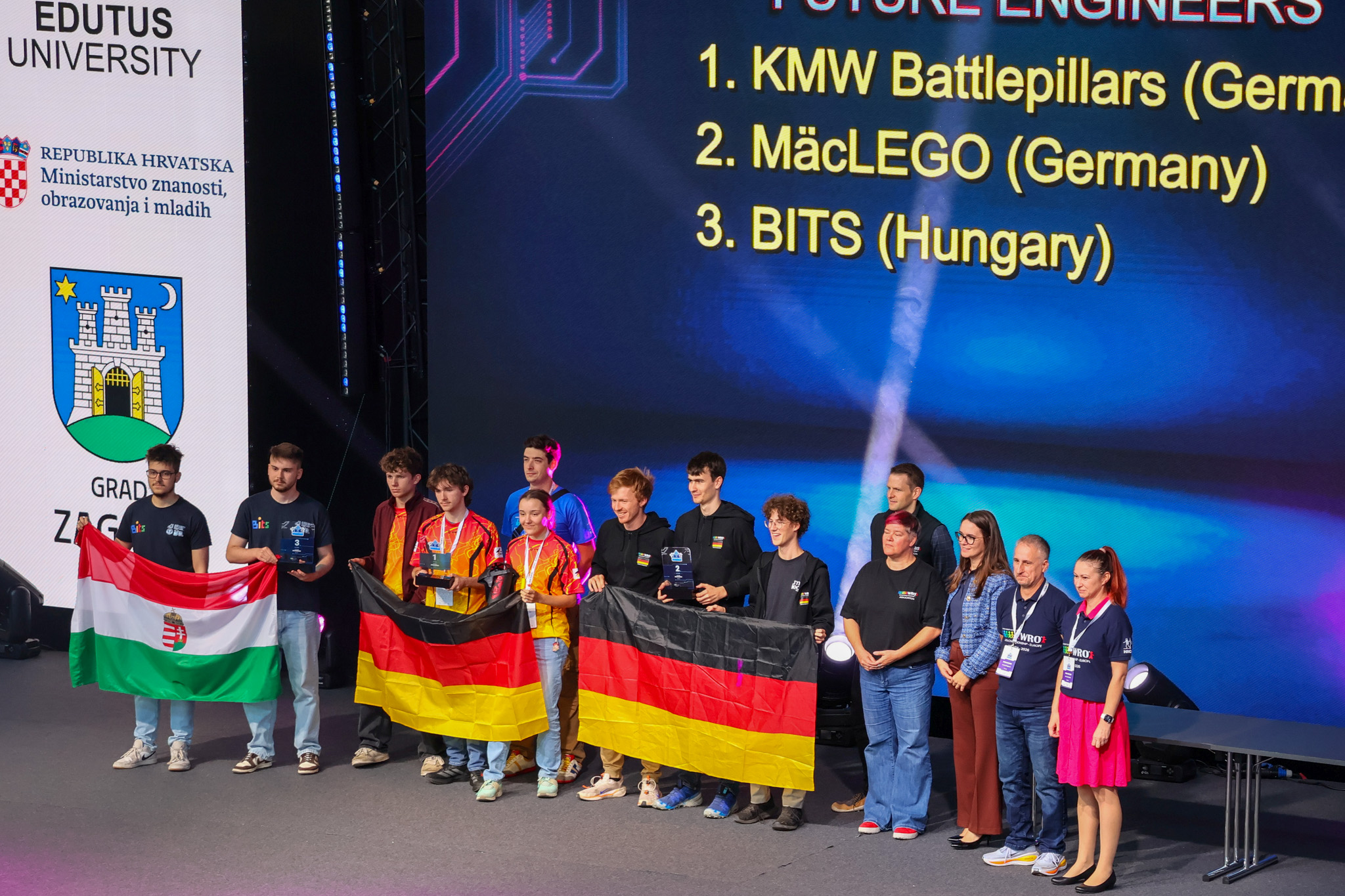
Two German teams and one Hungarian team secured places on the podium in the Future Engineers category. (Photo: Zoltán Erdélyi)
The brothers’ coach, Norbert Boros, Training Specialist at Széchenyi István University’s Adult Education and Skills Development Centre, has been involved in robotics education since 2014. “András has been with us from the very beginning, while Balázs joined his brother shortly afterwards. Since then, we have competed together in numerous competitions, but this is the first time we have achieved such a significant result at international level. I am particularly pleased that the boys are now involved in the programme not only as competitors but also by supporting younger participants and passing on the knowledge they have acquired,” he emphasised. He explained that the brothers had returned to competition after a year away and, this time, had entered with a completely self-built robot rather than relying on their previous LEGO-based solutions. The coach stressed that the young people's progress is a good example of what can be achieved through robotics education starting at an early age and supported over the long term.
The young men, who have just won bronze, are still taking part in the University’s Robotics and Programming micro-credential programme, while also supporting the development of primary and secondary school pupils. The University also offers an Interdisciplinary Robotics and STEM Skills Development – Robotics Specialisation course for teachers interested in the subject. The programme can be particularly useful for teachers, and vocational education and training instructors, since participants acquire up-to-date knowledge of robotics and programming, as well as teaching methods, that they can use to prepare their pupils for competitions such as the WRO and the First LEGO League.