 Chinese


International Legal Conference Brings Researchers from Ten Countries to SZE
The relationship between law, politics and science, and its implications for the judicial application of law, were at the centre of a two-day international conference at Széchenyi István University. Sixty-eight participants from ten countries attended in person or online. The event, which grew out of several years of Polish-Hungarian cooperation, was held outside Poland for the first time.
The conference, entitled “Between Politics and Science – Challenges of the Judicial Application of Law”, was recently held in Győr and organised by the Deák Ferenc Faculty of Law and Political Sciences at Széchenyi István University in cooperation with legal research groups at Jan Długosz University and the University of Opole. The partnership began with academic staff exchanges, and it has since developed into increasingly close academic cooperation. An important milestone in this process has been the regular participation in recent years of experts from Széchenyi István University in the Central European Legal and Administrative Forum, which was held for the seventh time.
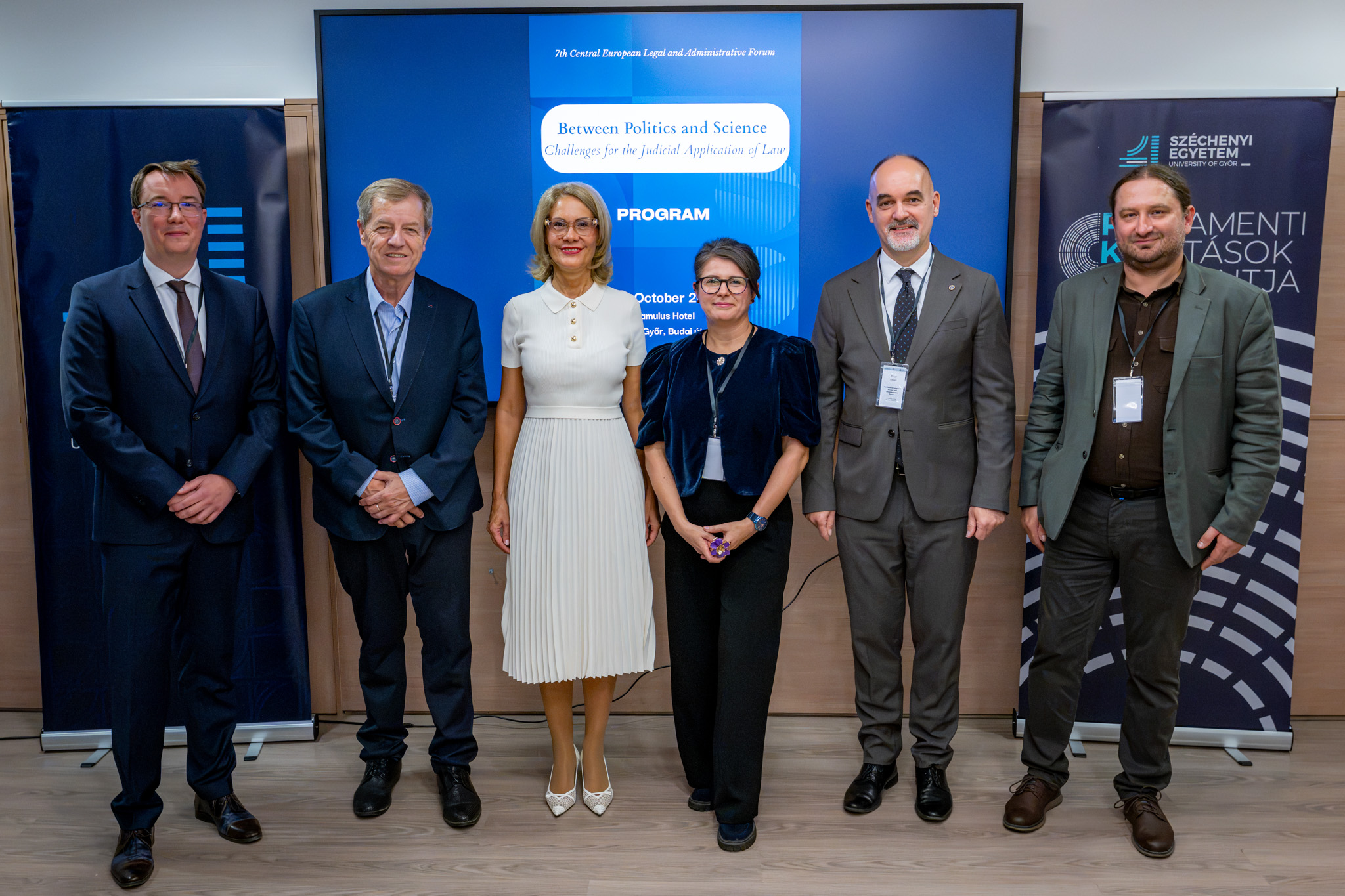
Associate Professor Dr Csaba Erdős, Vice-Dean for Social Relations at the Deák Ferenc Faculty of Law and Political Sciences, Széchenyi István University; Dr István Stumpf, Professor at the Faculty and former member of the Constitutional Court; Professor Dr Eszter Lukács, Vice-President for International Affairs and Strategic Relations at Széchenyi István University; Dr Paulina Bieś-Srokosz, lecturer at Jan Długosz University; Professor Dr Péter Smuk, Dean of the Deák Ferenc Faculty of Law and Political Sciences; and Dr Jacek Srokosz, lecturer at the University of Opole, at the opening of the conference (Photo: András Adorján)
At the opening ceremony, Dr Paulina Bieś-Srokosz, a lecturer at Jan Długosz University, welcomed the opportunity for participants to meet in person in Győr after lengthy preparations. Dr Csaba Erdős, Associate Professor at Széchenyi István University, highlighted that the event was the result of a partnership that has deepened over time and that preparations for a cooperation agreement between the three universities are already under way.
In her welcome address, Professor Dr Eszter Lukács, Vice-President for International Affairs and Strategic Relations at Széchenyi István University, emphasised that internationalisation means much more to the University than increasing the number of international students. “It is equally important to us that our academic and research staff work within professional networks, initiate joint research projects and build partnerships that benefit all partners in the long term,” she said. She added that the Deák Ferenc Faculty of Law and Political Sciences is playing an increasingly important role in this process. Nearly 50 international students are currently enrolled in its programmes, and the Faculty also launched a new English-language master’s programme in digital children’s rights and youth protection this academic year.
The Vice-President also emphasised that the topic of the conference in Győr was particularly timely. The participants sought to explore where the boundary between law and politics lies, how the application of law can address questions of a political nature, and how scientific and expert knowledge can be incorporated into judicial decisions.
In his welcome address, Professor Dr Péter Smuk, Dean of the Deák Ferenc Faculty of Law and Political Sciences at Széchenyi István University, emphasised that the strength of the cooperation with the Polish partners lies not only in the high quality of the academic dialogue but also in the participants’ familiarity with the social, political and legal realities of each other’s countries. In his plenary lecture, entitled “When the Government Speaks”, the Dean examined the constitutional limits of state communication and the role of expert knowledge, drawing primarily on the experience of US court cases.
As part of the plenary programme, Dr István Stumpf, Professor at Széchenyi István University and a former member of the Constitutional Court, reviewed debates on the rule of law using Hungary as a case study, addressing the intersection of legal and political approaches and the tensions between European integration and national constitutional identity. Dr Piotr Herbowski, Dean of the Faculty of Law and Economics at Jan Długosz University, examined issues in judicial practice concerning how individuals are notified about the use of covert surveillance, while Dr Agnieszka Zywicka, Professor at Jan Kochanowski University and a former member of the Supreme Court of Poland, discussed questions relating to the independence and impartiality of Supreme Court judges.
Across the eight sections held over the two days, participants covered a wide range of current issues. Topics ranged from electoral remedies and judicial independence to the role of expert knowledge in applying the law, legal issues related to climate change and migration, and the relationship between artificial intelligence and judicial decision-making.
The conference also served to further strengthen joint academic work. Two publication opportunities are associated with the conference: publication in Jan Długosz University’s own
periodical and in a special issue entitled Politics and Courts in the Storm of the Q1-ranked journal Frontiers in Political Science. The partners’ longer-term plans also include developing an international online research directory that could facilitate the identification of common research topics and potential co-authors.