Chinese


International research collaboration in focus as Finnish ambassador visits SZE
Győr, home to Széchenyi István University, was the destination of the first trip outside the capital by Finland’s newly appointed ambassador to Hungary. During his visit, Pekka Kaihilahti discussed Finnish-Hungarian relations and potential opportunities for cooperation in education and research with Professor Dr Eszter Lukács, the University’s Vice-President for International Affairs and Strategic Relations.
Finnish-Hungarian relations reached a significant milestone in recent days when Pekka Kaihilahti presented his credentials to Dr András Baka, President of Hungary, at Sándor Palace, officially taking up his post as Finland’s ambassador to Hungary. On his first visit outside the capital, the diplomat travelled to Győr, where, among other things, he learned about the activities of Széchenyi István University.
The ambassador was welcomed by Professor Dr Eszter Lukács, the University’s Vice-President for International Affairs and Strategic Relations, whom he had first met at a UNESCO conference in Budapest in September. During the visit, they discussed the University’s internationalisation efforts, its return to the Erasmus programme, and its research conducted through international research networks.
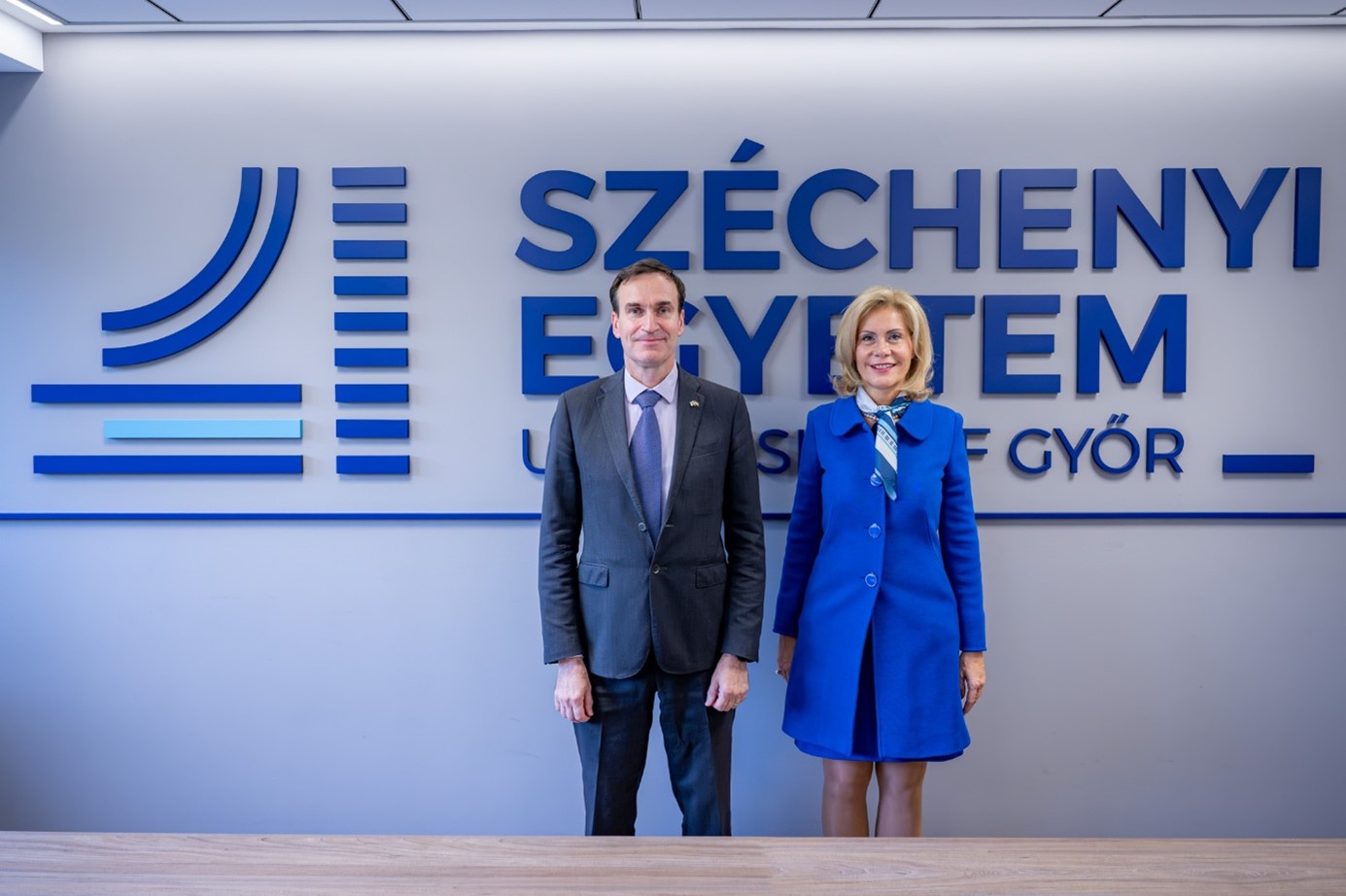
Pekka Kaihilahti, Finland’s ambassador to Hungary, and Professor Dr Eszter Lukács, the University’s Vice-President for International Affairs and Strategic Relations, during the visit. (Photo: András Adorján)
During the meeting, which also included a detailed presentation of the University, Professor Dr Eszter Lukács explained that returning to the Erasmus programme was hugely important for the University. “We previously worked closely with Häme University of Applied Sciences as part of the Regional University Network – European University (RUN-EU) consortium, and they were excellent partners. Two of our 1,600 international students are from Finland, both came to us from this university. This shows that the strong relationship between our universities has endured, and we hope to build on it to develop our cooperation further,” she said.
The Vice-President also highlighted Széchenyi István University’s international profile. “Of our nearly 280 study programmes, more than 60 are available in English. Alongside our nine faculties and four doctoral schools, the University is home to numerous research and competence centres that also participate successfully in international research projects, bringing academic knowledge together with the needs of industry and society,” she explained. She added that the University’s growing international standing was reflected in its inclusion in the global rankings published by Times Higher Education and Quacquarelli Symonds. “Of the approximately 30,000 higher education institutions worldwide, only the top 3,000 feature in these rankings, which puts us among the top 10% globally. That is an outstanding achievement in itself,” she noted.
During his visit, Pekka Kaihilahti also explored Győr’s city centre and visited the local government offices. He said he particularly liked the city’s historic streets and squares. “In Finland, the most innovative universities are those that also offer healthcare-related courses, conduct research in the field and operate a teaching hospital. One of these five Finnish institutions is the Kuopio campus of the University of Eastern Finland. As Kuopio is twinned with Győr, I see excellent opportunities for cooperation,” he said. The ambassador expressed his commitment to supporting Finnish-Hungarian cooperation in higher education and research, emphasising the importance of the Erasmus and Horizon programmes.