 Chinese


Learning in the diaspora: Széchenyi István University lecturers deliver teacher training in Germany
Lecturers from Széchenyi István University held a micro-credential course for teachers at Hungarian weekend schools in Germany. The three-day programme, held in Kastl-Mennersberg, Bavaria, focused on experiential learning, story and drama pedagogy in education, forest pedagogy, and the development of musical and partial abilities. A total of 35 participants received a micro-credential.
Széchenyi István University has long placed great emphasis on providing professional support to those who teach the Hungarian language and culture in diaspora communities. Last year, the University's lecturers delivered a continuing education programme awarding a micro-credential in Manchester, aimed at developing the methodological skills of teachers working in Hungarian weekend schools. This time, the programme continued in Germany, with Kastl-Mennersberg hosting the BUOD Education Training and Association Meeting, which brings together Hungarian organisations in Germany.
The event aimed to equip teachers of the Hungarian language and culture in Germany, as well as professionals working in local Hungarian communities, with new methods, practical ideas and insights gained from sharing one another's experiences. The training was led by Associate Professor Dr Viktória Gősi Kövecses, Director of Széchenyi István University's Centre for Teacher and Educator Training.
The programme's importance was underlined by the fact that, in addition to Dr Kornél Klement, President of BUOD, Dr Viktória Gősi Kövecses and Anikó V. Zombory, a member of the organisation's board and representative of its education working group, the participants were also welcomed by György Heidl, State Secretary for Social Relations. Diplomats from the Embassy of Hungary in Berlin and the Hungarian diplomatic missions in Düsseldorf, Stuttgart and Munich also shared their thoughts at the event. The speakers emphasised the importance of professional cooperation, the exchange of experience and the strengthening ties between Hungarian communities.
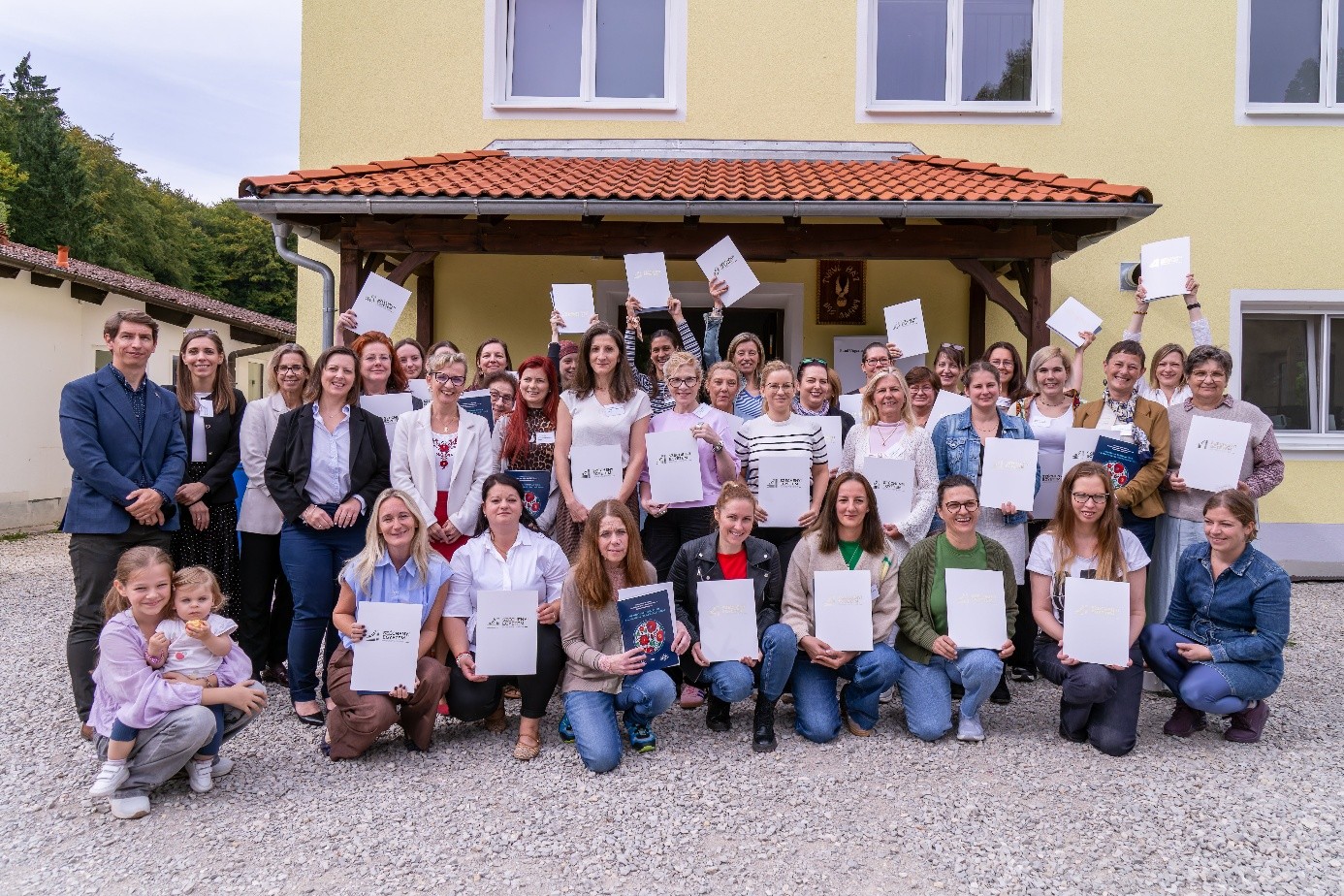
Course participants and instructors.
The training focused on practice-oriented, rotating workshops. Dr Anett Balogh-Pécsi, Assistant Professor and drama educator, introduced participants to drama lesson planning, while Dr Viktória Gősi Kövecses demonstrated the possibilities of storytelling-based education as a senior story therapist, through oral storytelling and playful activities. Associate Professor Dr Bálint Lampert, a forest educator, led a workshop titled ‘Treasure Hunt’ focusing on the principles of forest pedagogy.
Evelin Balogh, a qualified special educational needs teacher and Teaching Assistant, explained how specific partial abilities and component skills can be developed through Hungarian language and culture education. Meanwhile, under the guidance of Assistant Professor Dr Erzsébet Gáncs Várszegi, participants explored methods for developing musical abilities. The workshops all took an experiential approach: participants not only gained theoretical knowledge but also had the opportunity to try out methods that they could later apply in their own communities.
Alongside the professional training, the Association Meeting provided representatives of Hungarian communities in Germany with a forum for discussion and sharing experiences. At the end of the three-day event, participants reviewed the programme together, and 35 of them were presented with micro-credentials at the ceremony certifying completion of the course.
The programme in Kastl-Mennersberg also saw the launch of a book prepared by the course instructors, titled From Roots to Wings – Folk Traditions and Arts Education through a Project-Based Approach. The publication, available at diaszpora.sze.hu/kiadvanyaink-1, offers practical guidance for educators who pass on Hungarian culture and traditions.