Chinese


New acoustic booth at SZE supports speech development research
Széchenyi István University’s Apáczai Csere János Faculty of Humanities, Education and Social Sciences has expanded its research infrastructure with a new acoustic booth designed primarily to support research into speech development and speech therapy. The specialised environment allows speech to be recorded and analysed without background noise, and students at the Faculty can also take part in the research.
Recently, Széchenyi István University has made a range of technological investments to support teaching and research as part of a European Union-funded project. One of these was the installation of an acoustic booth at the Apáczai Csere János Faculty of Humanities, Education and Social Sciences.
Professor Dr Ottó Dóka, the project coordinator responsible for the procurement of laboratory equipment, explained that one of the key considerations was to ensure that the equipment purchased directly supported the development of educational programmes. “As a result, all nine faculties were able to expand their laboratory facilities with infrastructure tailored to their specific professional needs. The acoustic booth was one of the project’s most expensive equipment purchases, with an estimated value of HUF 32 million included in the successful funding application,” he said.
Dr Krisztina Zajdó, Associate Professor in the Department of Special Needs Education and coordinator of the speech therapy specialisation, initiated the installation of the booth. “Speech therapy is an important area of special needs education, and research in this field relies on being able to record and analyse speech in an environment free from external noise. My own research examines how Hungarian children’s speech develops, how different speech sounds emerge, and how the linguistic environment influences this process. The new acoustic booth provides a modern facility for this purpose, while also allowing us to involve our students in the research. During their studies, students can therefore become familiar with measurement and analysis methods that they will also be able to use in their future work in speech therapy,” she said.
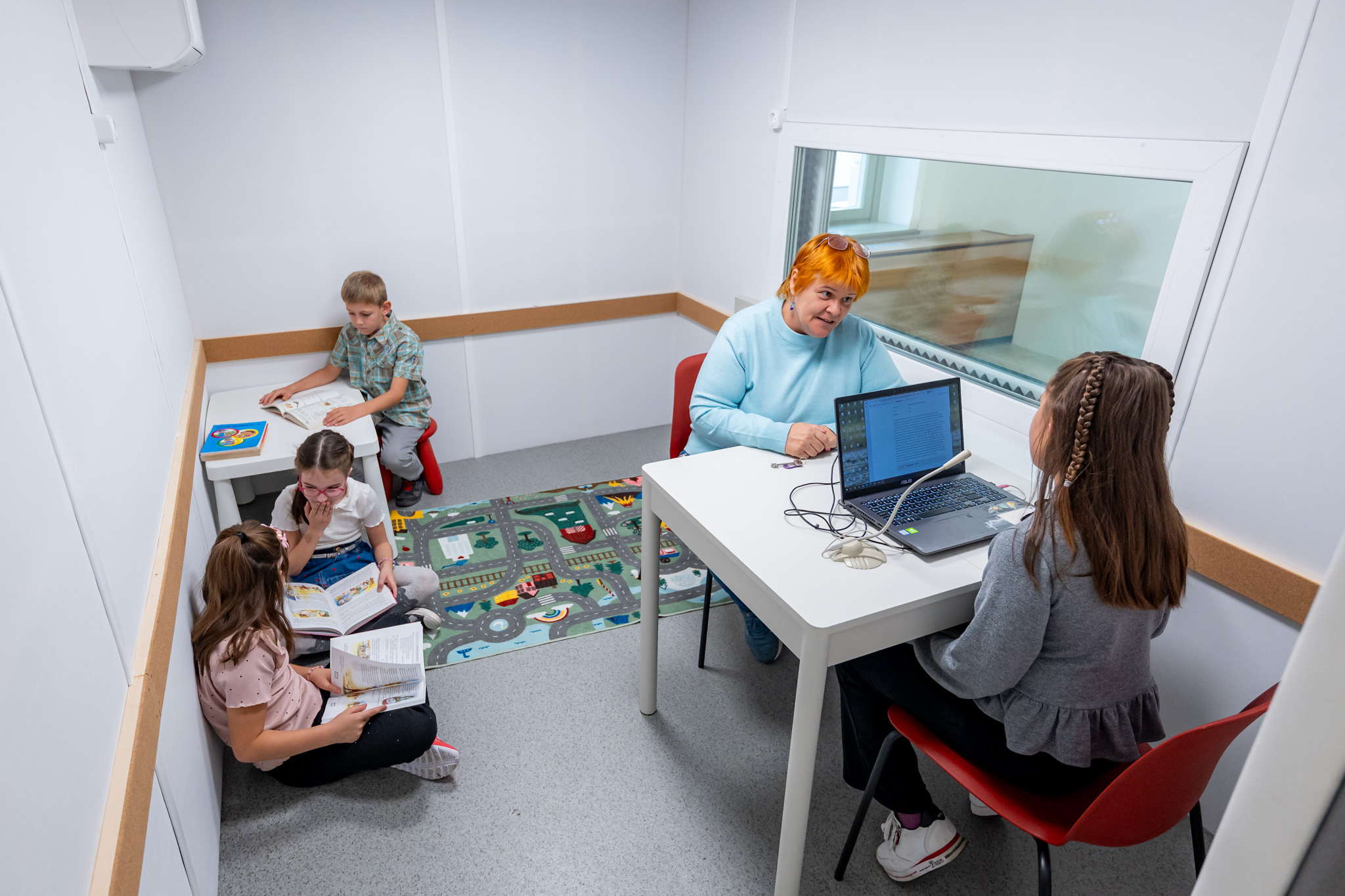
The new acoustic booth supports research into speech development and speech therapy at the Apáczai Faculty of Humanities. (Photo: András Adorján)
The soundproof booth also creates new opportunities for teaching phonetics. For example, students can use recordings of children’s speech made without background noise to examine the physical characteristics of speech production and the specific features of speech sound development. This allows them to gain practical experience with the technology during their studies.
Széchenyi István University has received HUF 3.323 billion in funding for the implementation of its project entitled “Infrastructure and Skills Development for Practice-Oriented Education at Széchenyi István University” (Project ID: RRF-2.1.2-21-2022-00028). The funding covers 100 per cent of the project’s total eligible costs and is provided as a non-repayable European Union grant. The project was implemented under Hungary’s Recovery and Resilience Plan, with financing from a central government budget allocation.