 Chinese


SZE Lecturer Contributes to the Preparation of NATO Cybersecurity Exercise
A lecturer from the Deák Ferenc Faculty of Law and Political Sciences of Széchenyi István University, Lieutenant Colonel Dr László Vikman, recently took part in the preparation of NATO’s largest cybersecurity exercise, Locked Shields. The expert represented Hungary at the event held in South Korea.
For a state, a cyberattack is not merely an IT issue, but can also affect day-to-day operations, ranging from energy networks to various public services. Participants are prepared for such complex scenarios through the international Locked Shields exercise, in the preparation of which Dr László Vikman, a lecturer at the Deák Ferenc Faculty of Law and Political Sciences of Széchenyi István University, was recently involved in South Korea. In the programme, organised by the NATO Cooperative Cyber Defence Centre of Excellence, countries simulate, across different scenarios, how to make decisions during a cyberattack, taking into account technical, legal and communication aspects, among others.
“This is a NATO defence exercise in which several countries work together on specific tasks and encounter realistic situations. In addition to technical defence, it is equally important which legal decisions are made, how communication with the public is managed, and what strategic steps are taken in a given situation,” said Dr László Vikman, who participates in the exercise in a so-called non-tech leader role, meaning that he supervises areas not primarily related to IT. “These include legal, media and strategic decision-making areas, their coordination and the management of emerging issues. In such cases, it is also a question of how the public is informed and in what form this takes place. Each country handles these situations in accordance with its own national rules and procedures,” he added.
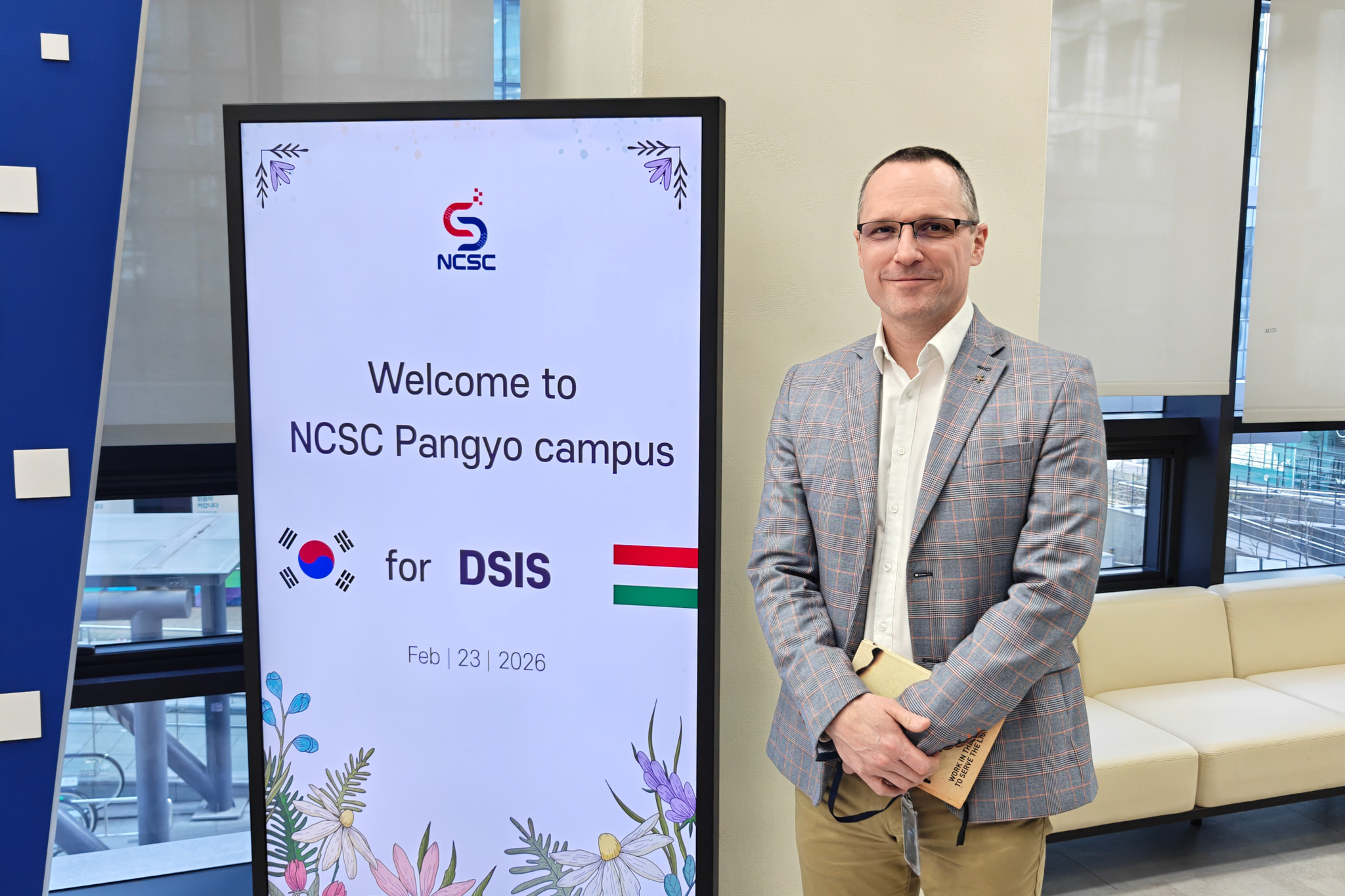
Lieutenant Colonel Dr László Vikman, a staff member of the Department of Modern Technology and Cybersecurity Law at Széchenyi István University, during a consultation related to the preparation of the Locked Shields exercise on the campus of the National Cybersecurity Centre in South Korea
The programme served as preparation: this year, Hungary and South Korea will participate in the exercise as a joint team. “The aim of the meeting was for experts from the two countries to coordinate their work, discuss the systems they will be working with, and determine the division of tasks between them,” he explained.
The experience gained during the exercise is also directly reflected in university education. “The scenarios change from year to year and are becoming increasingly complex, so even the preparation itself is a serious learning process. This knowledge is particularly valuable for students, as it helps them understand what decisions are made in specific situations and what consequences they entail. Digital threats are increasingly affecting economic actors as well, so this knowledge is also beneficial for those preparing to work in a business environment,” he emphasised, adding that in the future, students of Széchenyi István University may also become directly involved in the preparation through the PartnersRun programme.