Chinese


SZE’S Electric Kart Data Collection System Granted Utility Model Protection
SZE has once again secured utility model protection, this time for a comprehensive data collection system developed by its researchers for electric karts. In addition to providing data for analysing vehicle performance, the system also helps drivers improve their driving technique. The development is linked both to research into sustainable mobility and to the University’s professional activities in motorsport.
Sustainable mobility, electric vehicle technology and digitalisation play a key role in SZE’s research, development and innovation activities, as demonstrated by a solution that was recently granted utility model protection. Experts from the University’s Automotive Industry Research Centre and Digital Development Centre (DDC) have developed a complex data collection system which, when installed in electric karts, provides detailed information about vehicle performance and the driver’s technique behind the wheel.
The development was carried out as part of the Green Traffic Cloud (GTC) project, which aims, among other things, to promote environment-friendly vehicle technologies and intelligent mobility solutions. The researchers investigated the potential applications of an on-board data acquisition unit, using an electric kart as a test platform.
Dr Zoltán Pusztai, a researcher at the Automotive Industry Research Centre, explained that, unlike conventional passenger cars, karts do not have a standardised data collection system. Manufacturer-specific solutions are often incompatible with one another, and the information they provide is also limited. The researchers therefore developed a complex platform capable of processing data from several different types of sensors simultaneously.
“We equipped the kart with various sensors, including an inertial measurement unit, a differential GPS receiver, and wheel-speed and steering-angle sensors. The system also processes information from the electric powertrain and the battery monitoring system. By analysing these data together, we can not only monitor the vehicle’s technical operation but also assess the driver’s technique. We also tested the system with a driver under real track conditions,” the researcher explained. He added that, due to racing regulations and safety requirements, the full sensor system can primarily be used during training sessions and testing, although some of its components may also be suitable for use in competitive conditions.
Dániel Csikor, technical project manager at the Automotive Industry Research Centre, pointed out that the development is closely aligned with the University’s motorsport activities. The University has its own motorsport section, whose Uni Győr WMS team has also achieved considerable success in karting. He added that utility model protection provides legal protection for the technical solution developed at the University and may facilitate its future commercialisation. The technology could be particularly valuable to professional karting teams, which can use the measurement data to analyse vehicle setups and driver performance more accurately.
“Karting is one of the most important entry points into motorsport, where the preparation of racing drivers begins at a young age,” he said. “Our development therefore supports talent
development, as analysing the detailed data makes it possible to identify precisely where and how drivers can improve their technique. For example, it is possible to determine why a driver lost time in a particular corner and what they should change to achieve a faster lap time. The skills they acquire in this way can also be put to good use later in their careers as racing drivers.”
The University’s Higher Education and Industry Cooperation Centre played a major role in the process of obtaining utility model protection. Going forward, the University’s commercialisation company, Uni Inno Zrt., will make every effort to ensure the development achieves commercial success.
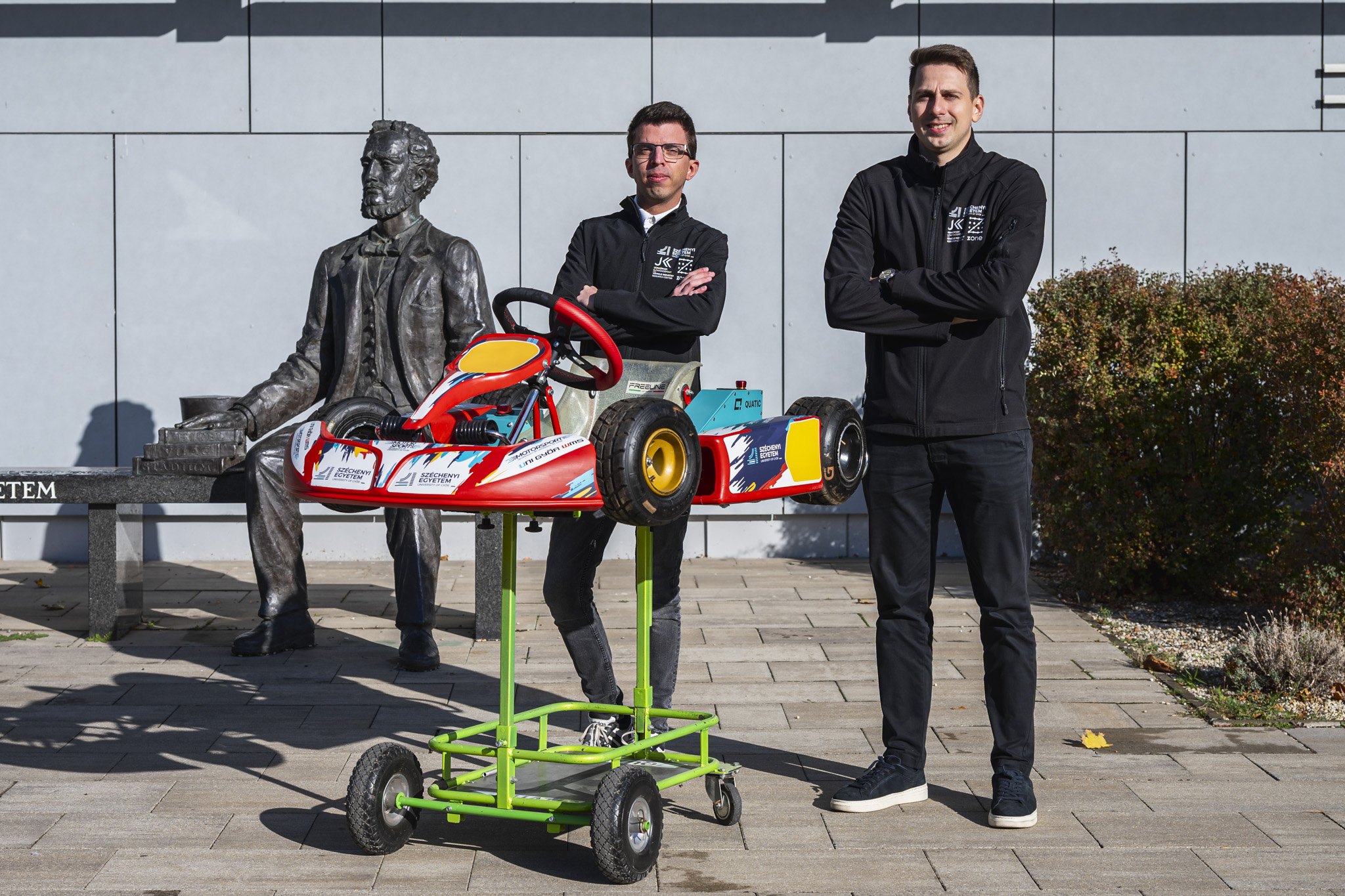
Dániel Csikor, technical project manager at SZE’s Automotive Industry Research Centre, and Dr Zoltán Pusztai, researcher at the Automotive Industry Research Centre. (Photo: Máté Dudás)