 Chinese


SZE’s Formula Student Team Unveils Its First Electric Car
In January, the Arrabona Racing Team announced that – following trends in the automotive industry and the Formula Student competition – it would replace the internal combustion engine with an electric drivetrain. Since then, the team has completed the first car of this new era, which it recently unveiled to the public. The model, named ART_12, will make its official debut in August in Croatia.
This year’s rollout event – the traditional occasion for presenting the new vehicle– attracted more attention than usual, as the Arrabona Racing Team (ART) revealed its first battery-powered race car. Much of the anticipation stemmed from curiosity surrounding the switch: what kind of design would the 2024 Hungarian race winner present in the electric category?
“Last year’s FS East victory was a historic moment and an unparalleled success in Hungarian higher education, also marking the dignified end of an era,” recalled Dr Eszter Lukács, Vice President for International Affairs and Strategic Relations at Széchenyi István University, in her welcome speech. “Today is a milestone for the team, which has bravely taken a new direction that also promotes sustainability. Our institution places great emphasis on training professionals with practical knowledge who are prepared for current challenges – a mission to which the activities of the Arrabona Racing Team greatly contribute,” she emphasised.

Dr Eszter Lukács expressed the University’s appreciation towards the team (Photo: Balázs Miklós)
Barna Tumpek, Head of Product Data Management and Homologation Support at Audi Hungaria Zrt. in Győr, also stressed the importance of student talent hubs in his speech. “Whenever I visit the campus, the lights are always on in the workshop, the work never stops. These talented, agile young people are professionally prepared and know exactly what it’s like to work on a project, to be flexible, to handle conflict. These are not skills that grow on trees, and Audi Hungaria greatly values them. In fact, many of our employees in recent years have come from the Arrabona Racing Team,” he said.

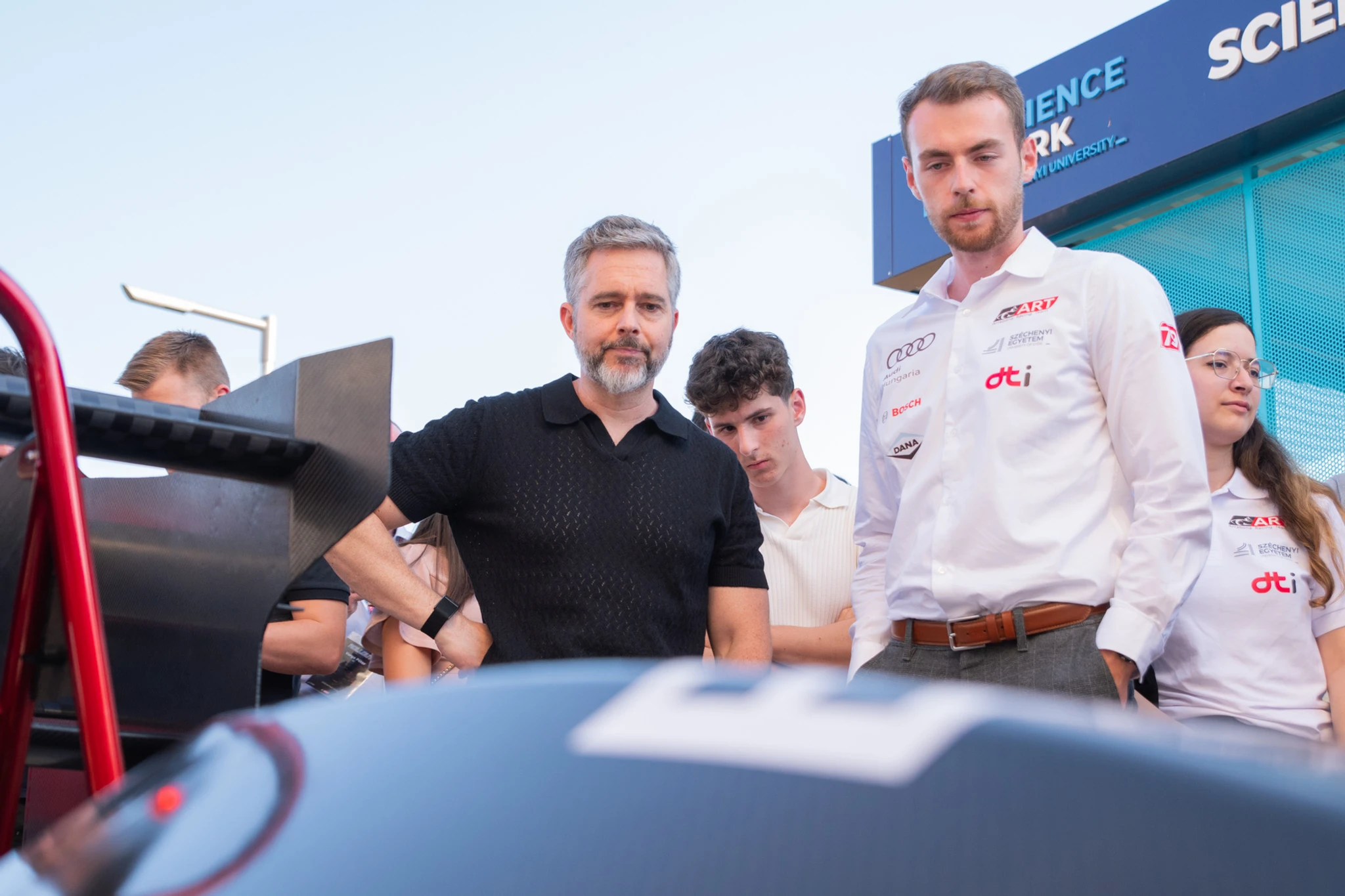
“The conceptual shift carried out by ART is something we see in the industry as well. It's excellent preparation for the world of work,” Tumpek added (Photo: Máté Dudás)
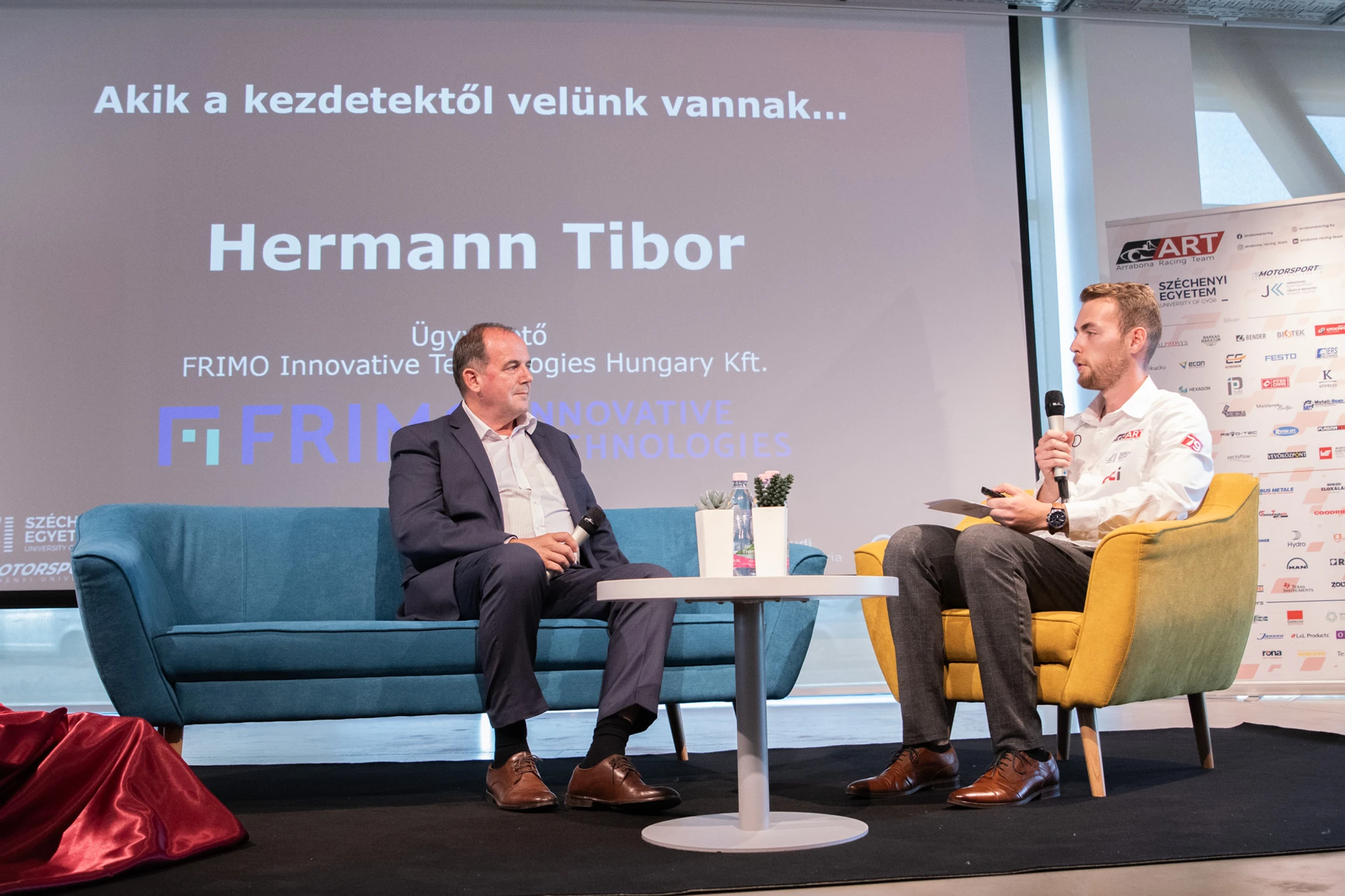
During the event, the audience also had the opportunity to listen to several panel discussions. First, on behalf of one of ART’s longest-standing supporters, FRIMO Hungary Ltd., Managing Director Tibor Hermann introduced the company. The firm manufactures custom-made components for the team, and in return, the students provide support in areas such as marketing. The company welcomes talented students both as interns and full-time employees.
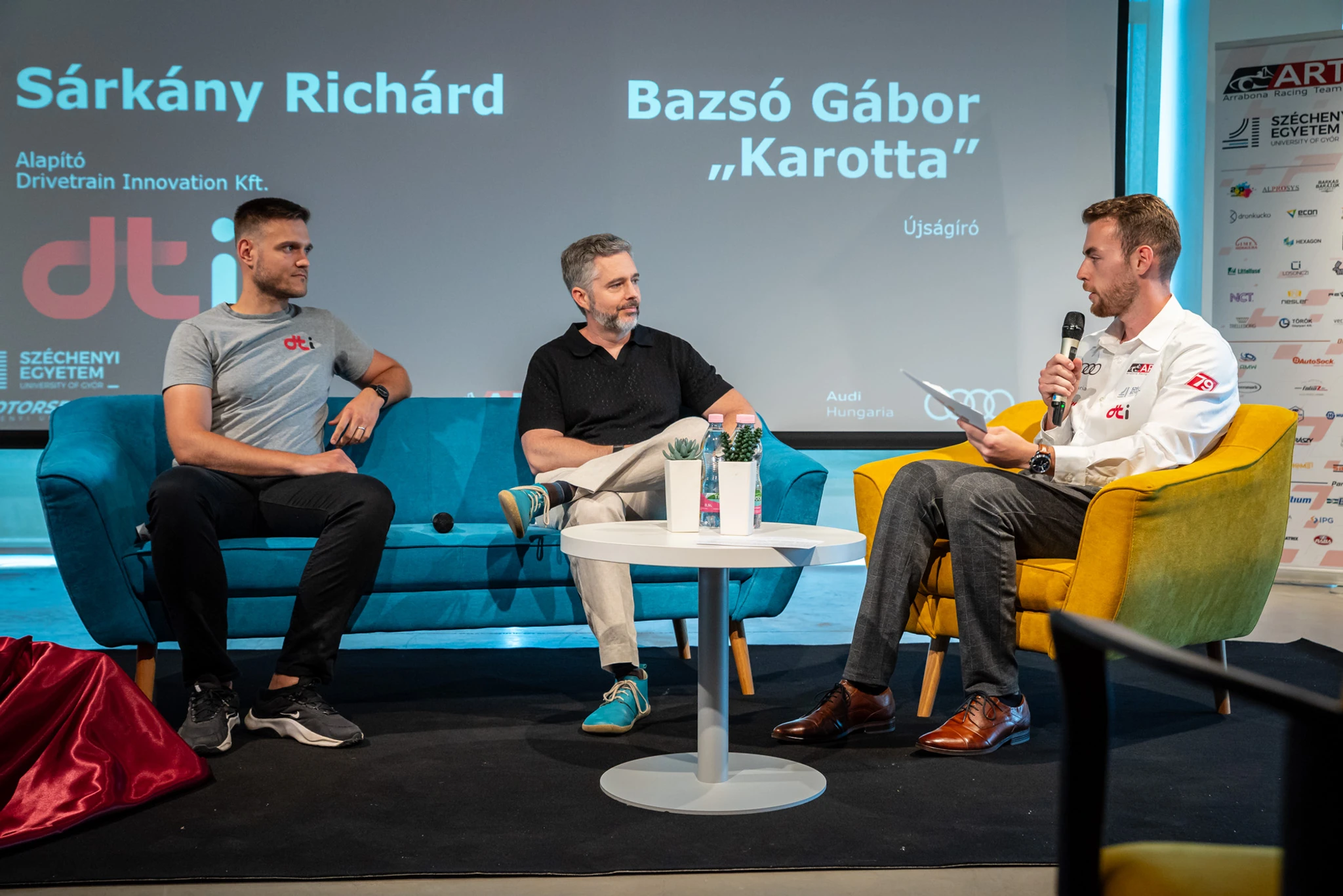
Next, Szilárd Bariska, Team Leader of ART, explained that despite the category switch, the team established more collaborations than ever before – a clear sign of the industry's growing openness to e-mobility and related innovative technologies. Among the new sponsors, Drivetrain Innovation Ltd. (DTI) stands out. The company provided its high-efficiency inverter – a frequency converter used for electric motors, specially developed for racing vehicles –to the Széchenyi University team for the first time. At the event, Richárd Sárkány, one of DTI’s founders, presented a previous project developed in collaboration with renowned automotive journalist Gábor Bazsó (“Karotta”).
Before the unveiling of the car, Szilárd Bariska reflected that by the end of last summer, everything was in place to commit to the change. “It took courage, as we left a well-trodden path for an uncharted one. And as 'petrolheads', letting go of the internal combustion engine was difficult, especially given our previous success. We are not the only team that competed in the internal combustion category last year and has now made the switch to electric. Many more teams are looking to enter the electric category, which clearly shows where the future of Formula Student lies,” he explained.

According to Szilárd Bariska, the category switch was enthusiastically welcomed by the University, sponsors, and team members (Photo:
Technical details of the ART_12 were presented by construction lead Mátyás Frech. “This year we started the design from a clean slate – no previous construction limited us. We are using completely new technology in our drivetrain. The battery pack delivers the maximum system voltage of 600 volts as permitted by the regulations. The cylindrical cell solution provides the highest possible operational safety. We intentionally oversized the system to explore its limits during testing, which allows for future slimming down,” he explained.
The silicon carbide-based inverters provided by DTI can operate with efficiencies exceeding 98 percent. While the previous car featured rear-wheel drive, the new design allows each wheel to be powered by a separate motor, enabling far more refined manoeuvrability. Since the regulations limit maximum power output to 80 kilowatts, increasing speed required a focus on enhancing downforce. This is achieved by the aerodynamic package: the previously large cooling system – originally designed for the combustion engine – could be significantly reduced, allowing for new side channels and, for the first time, side wings to be added to the car. The vehicle’s overall weight has also been reduced, thanks to a carbon composite body.

“We chose a one-and-a-half-stage transmission: it's the most robust at the smallest size while achieving the necessary gear ratio,” said Mátyás Frech, construction lead. (Photo: Máté Dudás)
“For a first electric car, I consider this model a major breakthrough – it's unique across the entire field. The team has implemented innovations not seen in any previous ART car, or even among other teams. There’s great potential in it, with plenty of scope for further development in the coming years,” said Márton Baráth, former team member and employee of Audi Hungaria Zrt. He added that electric propulsion has both advantages and disadvantages when it comes to operational safety. “With fewer moving parts, there’s a lower chance of pipe rupture or leakage, reduced vibration, and a less vulnerable cooling system. However, electric controllers are extremely sensitive – if any value exceeds a threshold, the system immediately shuts down, which can cause temporary or total stoppage,” he emphasised.
Finally, Szilárd Bariska revealed that, following the announcement of the cancellation of this year’s FS East event, the team’s first competition will now take place at the FS Alpe Adria in Croatia in August. Until then, they plan to carry out extensive testing.

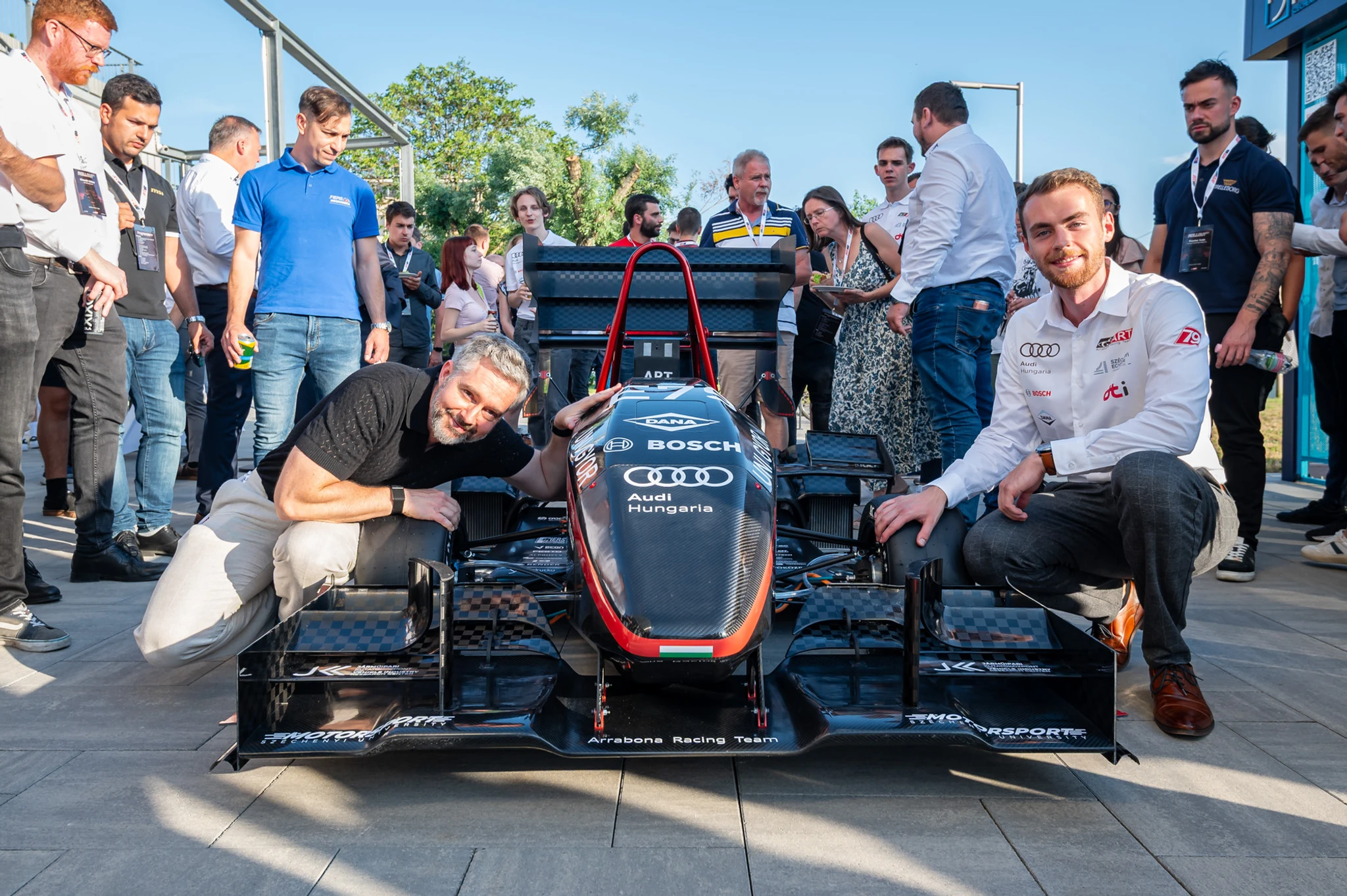
A symbolic moment of transition: last year’s internal combustion car unveiling the ART_12 (Photo: Máté Dudás)

The Arrabona Racing Team and the first car of the electric era, ART_12 (Photo: Máté Dudás)





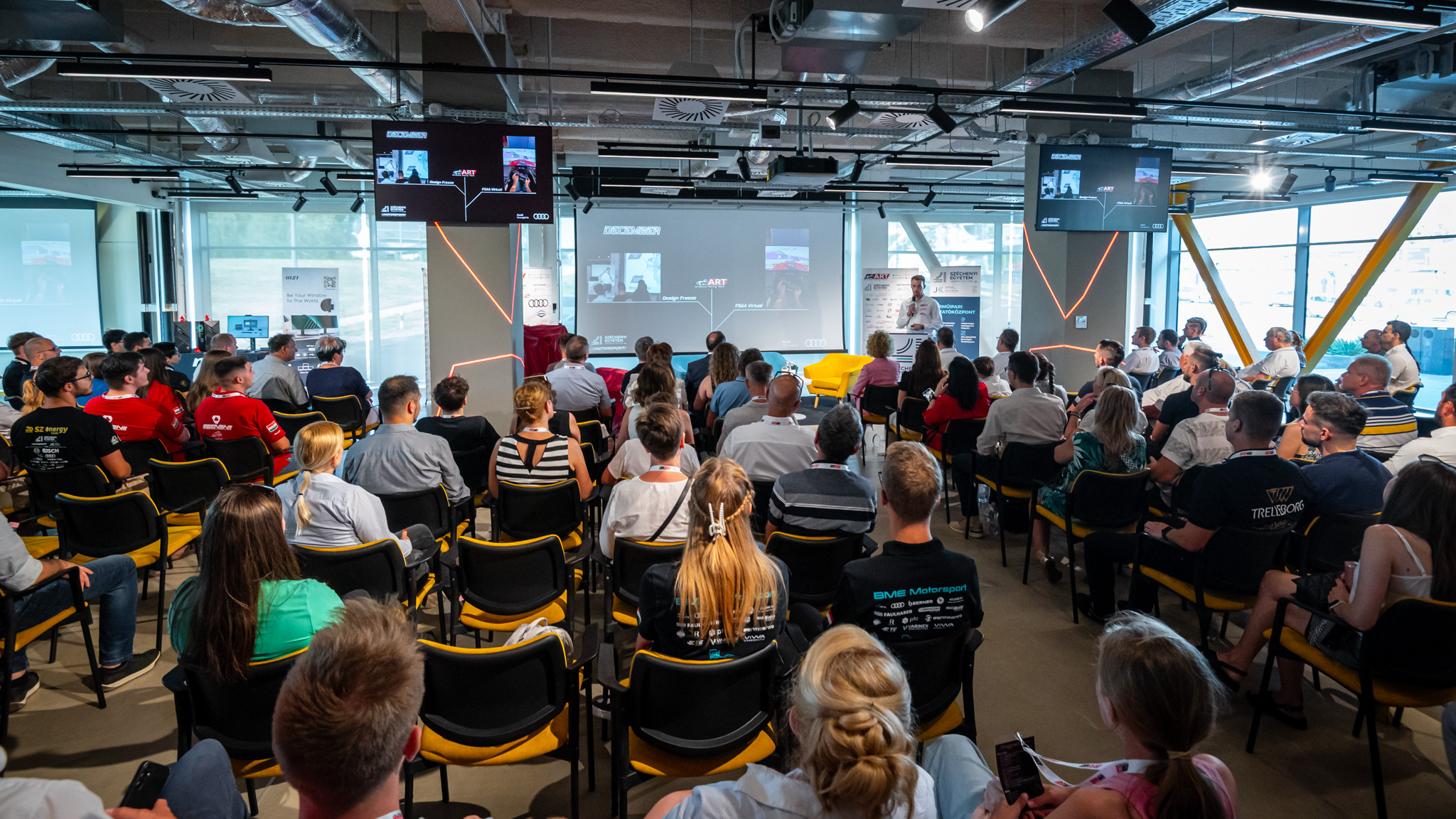


Event photo gallery (Photos: Máté Dudás, Balázs Miklós)