Chinese


SZE’s Yield Forecasting Model Helps Farmers Plan Ahead
The model developed at Széchenyi István University's Agricultural and Food Industry Research Centre makes it possible to estimate expected crop yields even months before harvest. Based on satellite imagery and meteorological data, the solution enables farmers to make more informed decisions about sales and storage. The service, developed from university research, is already being used across several thousand hectares.
In agriculture, receiving a reliable estimate of expected yields as early as during the growing season can offer farmers a significant economic advantage. The service, developed from research carried out by Széchenyi István University's Agricultural and Food Industry Research Centre (AÉKK), is commercialised by Uni Inno Zrt. with the Centre's professional support, and has been used by industry partners since 2025. The method is currently proven effective for forecasting winter wheat yields.
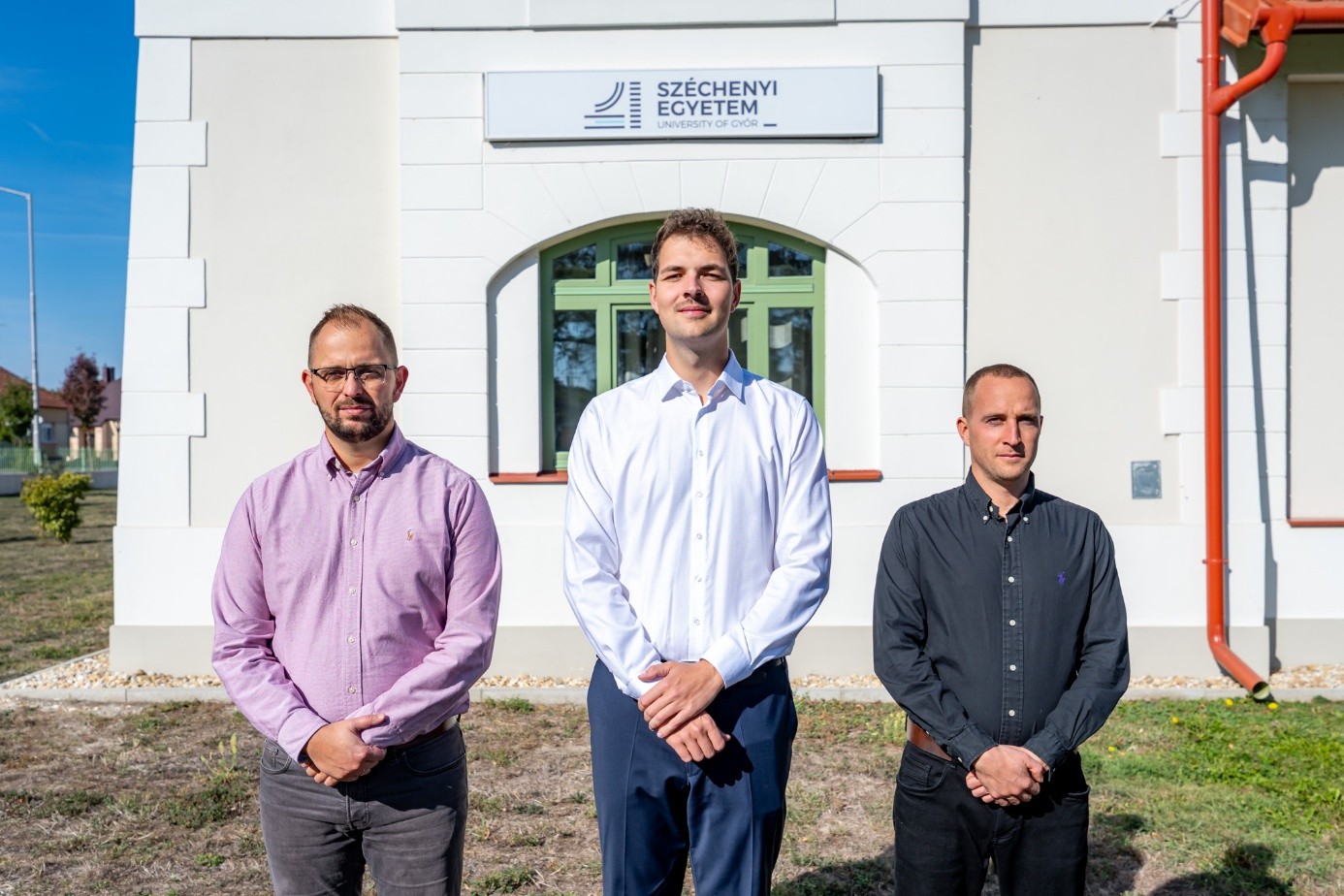
Staff of Széchenyi István University's Agricultural and Food Industry Research Centre: Dr István Kulmány, Head of the Agricultural and Food Industry Research Centre and Assistant Professor at the Albert Kázmér Faculty of Agricultural and Food Sciences; Áron Licskai, Research Assistant; and Dr Sándor Zsebő, Research Engineer. (Photo: András Adorján)
The work stemmed from a doctoral thesis that initially explored how data collected by drones could be used to estimate yields on small plots of land. "By the end of the research, we had achieved a result that we felt was worth putting into practice. We therefore further developed the method to create a service that could be used across larger areas and provide direct support to farmers," said Dr István Kulmány, Head of the Agricultural and Food Industry Research Centre and Assistant Professor at the Albert Kázmér Faculty of Agricultural and Food Sciences.
The system uses satellite imagery to monitor the condition and development of vegetation, combining growth indicators derived from these images with data from ground-based weather stations. To ensure the most accurate possible forecasts, the model is calibrated to the specific characteristics of each farm.
Assistant Professor Dr István Kulmány emphasised that early forecasting also provides valuable information from an economic perspective. "With this information, farmers can plan their income and storage capacity more accurately, as well as decide how much of their crop to sell in advance. In the case of winter wheat, under certain conditions, we can provide an estimate of the expected yield as early as March. This enables farmers to make more informed decisions about whether to sell part of their crop in advance or store it after harvest and look for suitable market opportunities later," he explained.

The yield forecasting model developed at Széchenyi István University can estimate expected crop yields several months before harvest.
In 2025, the Agricultural and Food Industry Research Centre carried out yield forecasts across nearly 4,000 hectares for a partner in Slovakia. The estimated average farm yield differed from the actual figure by approximately 200 kilograms per hectare. This year, the method is being used by an agricultural company based in Mosonmagyaróvár, where the margin of error has remained below 100 kilograms per hectare. Experience to date shows that, at farm level, expected yields can typically be estimated with an accuracy of 100–400 kilograms per hectare, although the margin of error is also influenced by the size of the area surveyed and variations in environmental conditions. With its current resources, the Research Centre can provide this service across approximately 25,000–50,000 hectares. Further automation of the processes could increase this capacity.
"Uni Inno Zrt. is responsible for bringing developments with commercial potential originating at the University to the market. In this case, we are no longer talking simply aboupromising research finding or prototype, but about a service that is already being used in an operational agricultural setting. Through this service, we have successfully fulfilled orders from the Hungarian and Slovak agricultural companies mentioned above. This demonstrates that the development offers a practical solution to farmers' needs and has the potential for international application. Our aim is to make the service available to as wide a range of users as possible, while further operational data will help us refine the model," said Bálint Szüle, Business Development and Technology Manager at Uni Inno Zrt., the University's commercialisation company, and the Higher Education and Industry Cooperation Centre.
The method is currently used primarily to predict winter wheat yields, but the researchers are already working to expand its application, following a request to develop regional models for grain maize as well. Bachelor's, master's and PhD students are involved in further developing the technology, and the research also provides topics for degree theses and Student Research Conference papers. Assistant Professor Dr István Kulmány emphasised that this is a team effort: bringing together university research, students' knowledge and the practical needs of farmers makes it possible to turn scientific findings into solutions that can be directly applied in agriculture.