 Chinese


Transport Safety Conference at SZE: E-Scooter Accidents Rising, Regulation Urgent
Over the past two and a half years, 140 people have suffered fatal accidents while travelling by micromobility devices—mostly e-scooters—and injury cases have become a daily occurrence. These figures were highlighted at the fourth national Transport Safety Conference organized by SZE and several professional organizations.
The Transportation Safety Conference, organized by SZE and co-organizers, provided an opportunity, for the fourth time, for relevant professionals to discuss current issues in the field. This year's programme placed a particular emphasis on electric scooters, which present an increasingly pressing transport safety problem. At the event, held on 17–18 September, Dr Diána Henézi, Vice-Dean for Educational Affairs of the Faculty of Architecture, Civil Engineering, and Transport Sciences, welcomed participants, followed by Dean Dr János Szép who opened the event. Dr Csaba Kerékgyártó, Secretary General of the Association of Hungarian Insurance Companies (MABISZ), pointed out that in Hungary, approximately six million motor vehicle insurance policies are currently in force, which in itself indicates the importance of transport safety. Professor Dr Péter Földesi, Head of the University's Department of Logistics and Transportation, drew attention to the long-term adverse occupational health hazards affecting professional drivers.

Tamás Berta, President of the Transportation Safety Division of the Scientific Association for Transport, Dr. János Szép, Dean of the Faculty of Architecture, Civil Engineering, and Transport Sciences at SZE, Zsolt Barna, State Secretary for Road Transport Affairs, Professor Dr Péter Földesi, Head of the University's Department of Logistics and Transportation, and Dr Ramón Farkas, Head of the Life Insurance Sector of the Association of Hungarian Insurance Companies at the opening of the conference. (Photo: András Adorján)
Zsolt Barna, State Secretary for Road Transport Affairs, explained that the Ministry of Transport and Investment intends to address transport safety with greater emphasis than in the past, prompting the establishment of a dedicated Transport Safety Department within the Ministry. Regarding e-scooters, he noted that around 360,000 people had recently shared their views via an online questionnaire. "We are currently analysing the responses, but it is already evident that respondents overwhelmingly support regulatory interventions aimed at enhancing transport safety," he emphasised. He highlighted that a draft legislative amendment regulating e-scooters would soon be submitted to the government, and that preparations for amending the Highway Code are also underway.
In the conference’s plenary session, in his presentation titled "Micromobility Accidents Involving Personal Injury in Hungary" Dr Ramón Farkas (MABISZ) showcased new research results co-authored by Dr Nóra Mészárosné Krizsik (Institute for Transport Sciences and Quality Control in Building), and Dr Tibor Mocsári (Hungarian Public Roads Zrt.). Their findings reveal that while micromobility devices—primarily e-scooters and e-bikes—were involved in 5.7 per cent of accidents in 2024, this figure rose to 10.2 per cent in the first five months of 2026. The number of people injured in such accidents stood at 784 in 2024, rose to 1174 in 2025, and has already reached 543 in the first five months of 2026. The experts stressed that statistical latency remains high, meaning the actual number of cases could be substantially higher.
Based on the data, 62 accident blackspots were identified nationwide, 50 of which are in Budapest and 12 in other major cities, including Győr. Over the two-and-a-half-year period under review, 140 accidents resulted in fatalities; however, only one of these occurred at such a blackspot.
It was further noted that the number of micromobility devices in Hungary is estimated at approximately 120,000. While electric-assist bicycles are predominantly popular among adults and the older generation, e-scooters are primarily used by 15-to-18-year-olds, who also account for the highest proportion of those injured and those causing the accidents. Inappropriate speed selection stands out as a major cause of e-scooter accidents. The experts therefore advocated for a combined approach combining education, infrastructure development, regulation, and enforcement. Potential measures proposed included age thresholds, setting technical requirements for the vehicles, and making helmets and insurance compulsory.
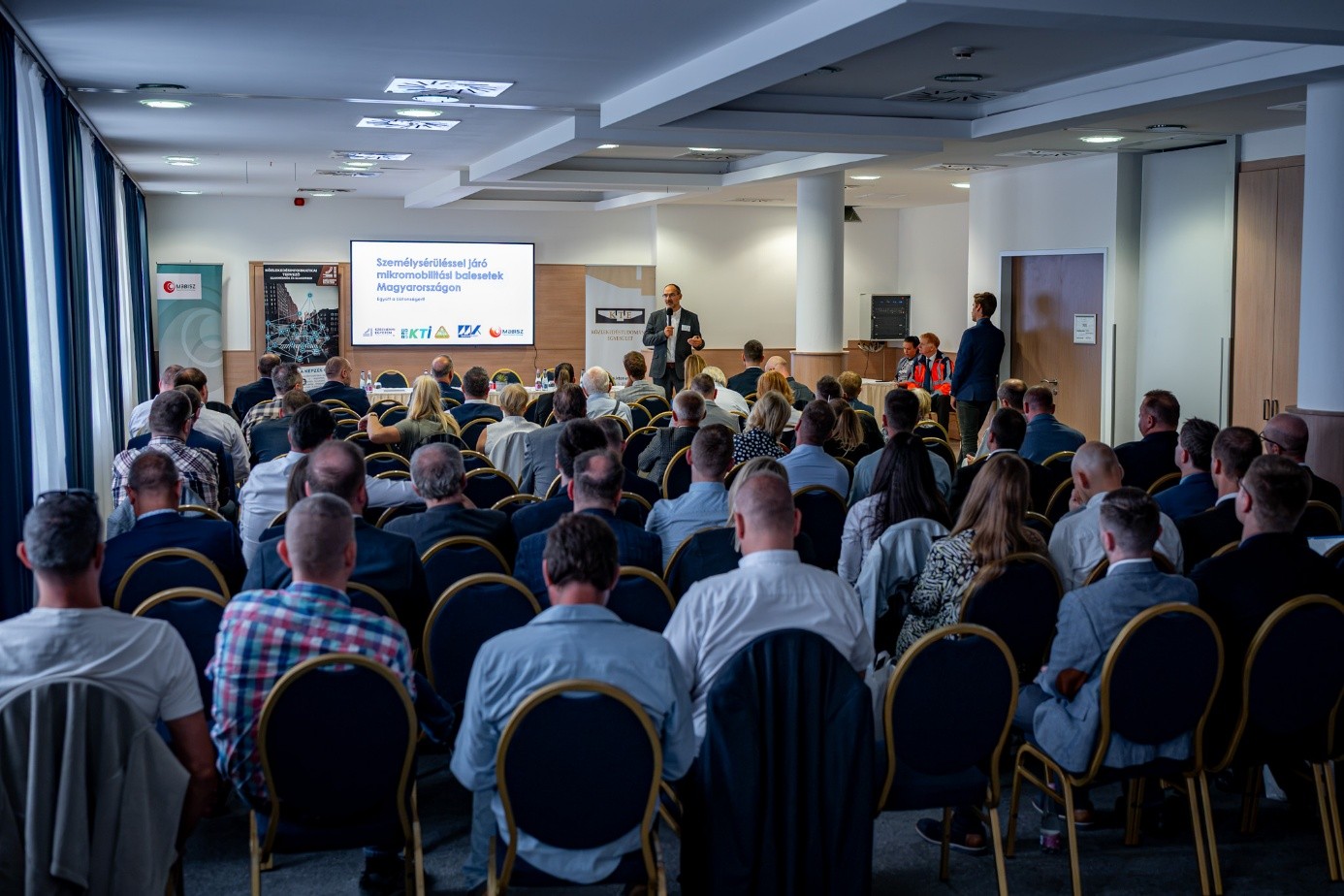
During the plenary presentation, experts present data demonstrating the need for regulation. (Photo: András Adorján)
The presentation was followed by a panel discussion, during which Bálint Madarász-Losonczy, Head of the Active Mobility Department at the Ministry of Transport and Investment, referred back to the questionnaire on scooters. He noted that 95 per cent of respondents support regulation, which in his view demonstrates a clear demand to define who can use these devices, where, and under what conditions.
Roland Rosta, Secretary of the Accident Prevention Committee of the Győr-Moson-Sopron County Police Headquarters, emphasised that the number of injury-causing scooter accidents in the county stood at 34 in 2024, 68 in 2025, and has already reached 67 in the first eight months of 2026. Underscoring the vital role of education, he introduced the police's "E-Robi" (Safe on an Electric Scooter) programme, which introduces school students to steps they can take to ensure traffic safety.
Dr Róbert Kőnig, a paediatric surgeon and paediatric traumatologist, shared his experiences with accidents involving the 8-to-17 age group. He explained that facial and cranial injuries, as well as concussions, are frequent, followed closely by abdominal injuries. In his view, mandating the use of full-face helmets could reduce the number of severe head injuries by at least half.
Tamás Berta, President of the Transportation Safety Division of the Scientific Association for Transport, also drew attention to the fact that these devices have proliferated due to their practical utility and clear advantages for urban transport. However, the high number of accidents among children justifies the introduction of age limits. Representing MABISZ, Tamás Tallárom highlighted the significance of the completed study, which has allowed critical insights for an area constrained by severe data scarcity.
The panel discussion participants agreed that Highway Code education, supplemented by practical skills training, should begin as early as primary school to enable young people to participate responsibly in road transport. They concluded that the implementation of speed limits and their consistent enforcement to be of equal importance.
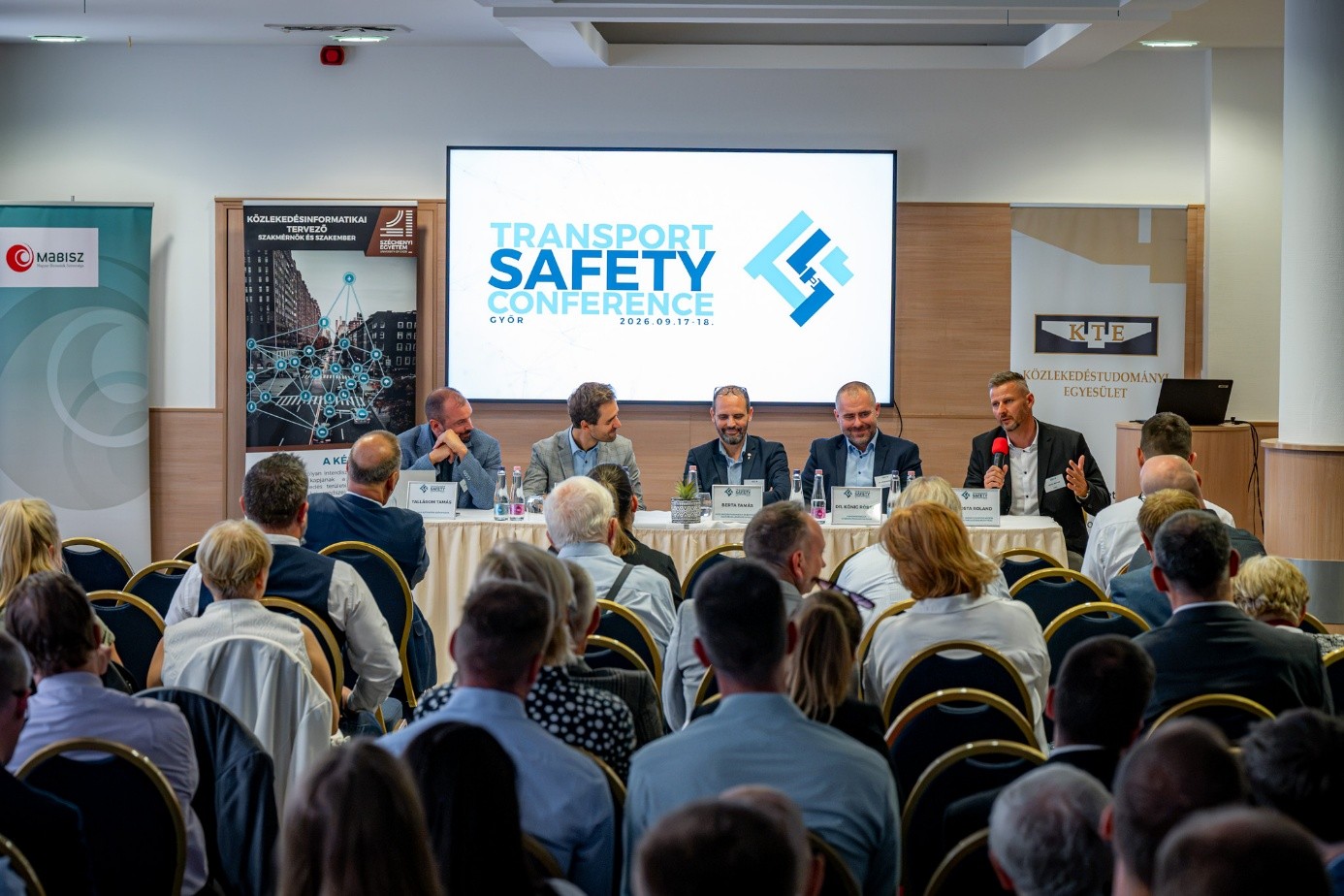
Tamás Tallárom, representing MABISZ, Bálint Madarász-Losonczy, Head of the Active Mobility Department at the Ministry of Transport and Investment, Tamás Berta, President of the Transportation Safety Division of the Scientific Association for Transport, Dr Róbert Kőnig, paediatric surgeon and paediatric traumatologist, and Roland Rosta, Secretary of the Accident Prevention Committee of the Győr-Moson-Sopron County Police Headquarters, discuss the transport safety dimensions of e-scooter use during a panel discussion. (Photo: András Adorján)