Chinese


“Young Lawyers along the Danube” Conference
Hungary’s Minister of Justice, the Presidents of the Hungarian and Bavarian Constitutional Courts, renowned legal scholars, and lecturers and young researchers from numerous prestigious European universities attended an international comparative law conference held at SZE on 17 November. Building on one of the initiatives launched by the Hungarian-German Youth Parliament, established last year, the event in Győr aimed to strengthen legal cooperation between the countries along the Danube and lay the foundations for a joint research project.
The Hungarian–German Youth Association and SZE worked closely together to organise the first Hungarian–German Youth Parliament in November 2025, in the Upper House Chamber of the Hungarian Parliament. The event brought together 130 young people from Hungary and Germany, who discussed matters of shared interest in parliamentary committees and a plenary session, and adopted 16 resolutions aimed at deepening relations between the two countries. One of the aims of the initiative was to launch a comparative law research project in which students and young researchers from universities in the countries along the Danube could take part.
The international conference entitled “Young Lawyers along the Danube”, held at SZE on 17 November, was another step towards achieving this aim. It was organised by the University’s Deák Ferenc Faculty of Law and Political Sciences, the Hungarian–German Youth Association and the Institute for East European Law in Regensburg. The event’s partners included the University of Regensburg, the University of Passau, the University of Augsburg, the University of Vienna, Hof University of Applied Sciences, Andrássy University Budapest and the Hungarian–German Youth Council. Students from other renowned higher education institutions also took part, including Freie Universität Berlin, the University of Tübingen and all universities in Hungary offering law degrees. The conference in Győr was designed to establish a scientific basis for the comparative study of the legal systems of the countries along the Danube and to foster long-term international cooperation among young lawyers.
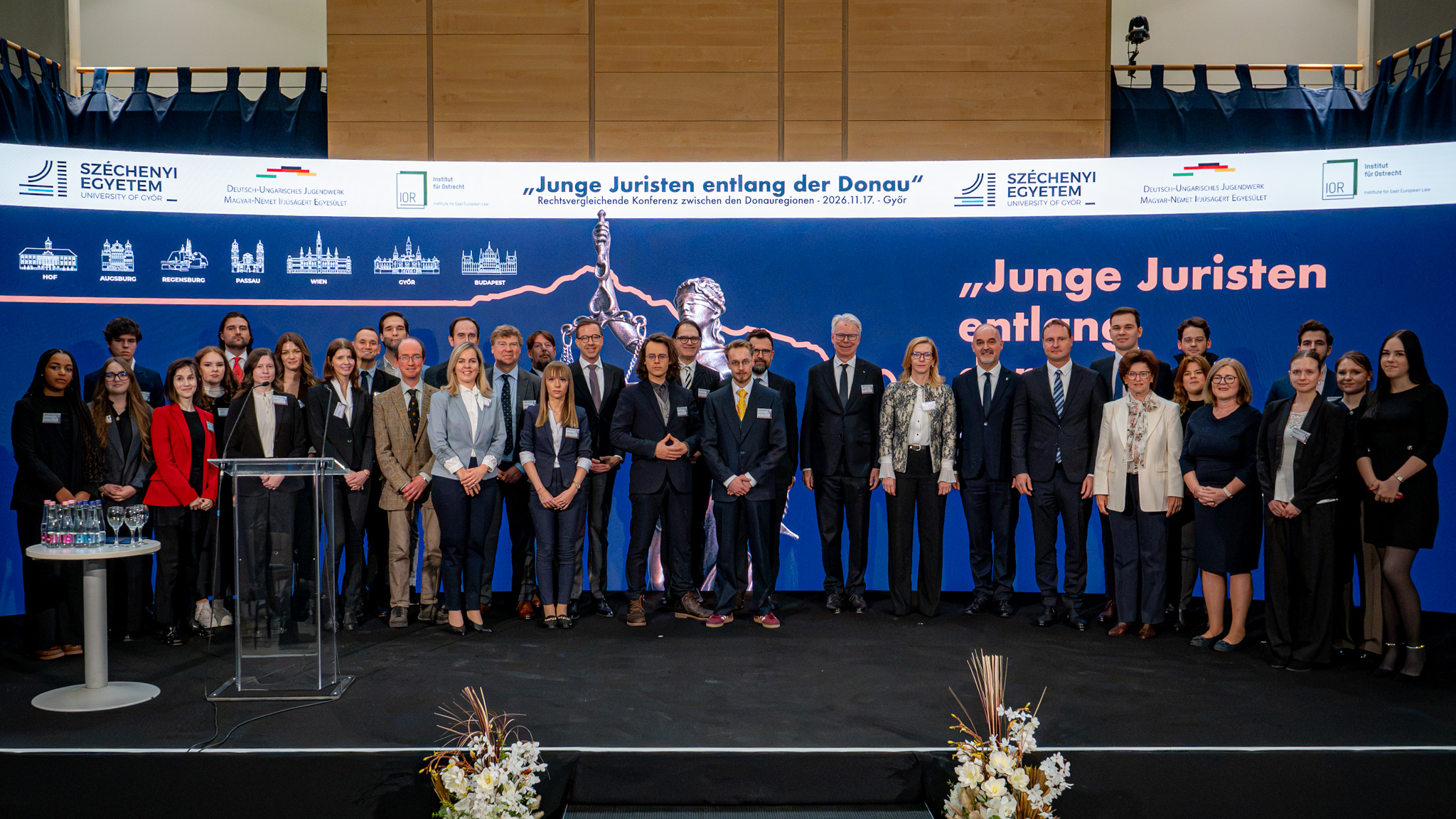
Numerous judicial leaders and renowned legal scholars, as well as doctoral students from Hungary, Germany and Austria, took part in the “Young Lawyers along the Danube” conference held at SZE. (Photo: András Adorján)
The conference was opened by Dr Erzsébet Knáb, President of the Hungarian–German Youth Association and Founding President of the foundation that maintains SZE. In her welcome address, she recalled that a ten-member youth council comprising young people from Hungary and Germany had been established to implement the resolutions adopted at last year’s Youth Parliament. The scientific sessions of the conference in Győr had also been organised based on the council’s proposals. She emphasised that one of the initiative’s most important achievements was that the young people’s ideas had led to tangible international cooperation. “This is a particularly fine example of what can be achieved when we not only listen to young people but also take their ideas seriously, support them on their journey and give them the opportunity to flourish and bring about change themselves,” she said.
In his welcome address, Dr Bálint Filep, President of SZE, highlighted the importance of the University’s international network of partnerships. He noted that the University has nine faculties and around 17,000 students, including nearly 1,700 international students from 92 countries. Prospective students can choose from 64 English-taught programmes. “Győr’s geographical location, history and economy mean that it has close ties with the Danube region, particularly with the German-speaking world. It is therefore especially pleasing to see lecturers and students from German, Austrian and Hungarian universities coming together here, bringing new substance to these partnerships. The University maintains Erasmus+ student and staff mobility partnerships with 42 German and 17 Austrian universities, and these could gain fresh momentum in the future once the restrictions imposed on Hungary are lifted,” he emphasised. Commenting on the significance of the conference, he stressed that dialogue between experienced professionals and lawyers at the beginning of their careers is valuable to both sides, as it contributes to the development of the academic community.

The atrium of the University’s New-Knowledge Centre in Győr was filled with participants attending the conference organised by SZE, the Hungarian–German Youth Association and the Institute for East European Law in Regensburg. (Photo: Máté Dudás)
Roland Kósa, Deputy Mayor of Győr, also welcomed the participants. He emphasised that the Danube has connected the countries, cultures and economies of the region for centuries, and that the conference offered a new opportunity to strengthen cross-border legal cooperation. “Although our legal concepts are closely related, national regulations and procedures differ. It is the task of the younger generation of lawyers to explore these differences and find common ground, which is essential for day-to-day cross-border partnerships and for the effective operation of cross-border institutions such as European Groupings of Territorial Cooperation (EGTCs),” he said. He also pointed out that the countries along the Danube are addressing a range of common issues, from the regulation of shipping and environmental protection to trade and the digital economy.
Gábor Tordai-Lejkó, Hungary’s Consul General in Munich and Doyen of the Bavarian Consular Corps, recalled the more than 1,000-year history of Hungarian-Bavarian relations. He emphasised that these historical and cultural ties are reflected today in close economic and scientific cooperation: Bavaria is Hungary’s most important trading partner among the German federal states. “All this also requires strong intellectual and scientific foundations, as reflected in our shared commitment to scientific excellence,” he stated.
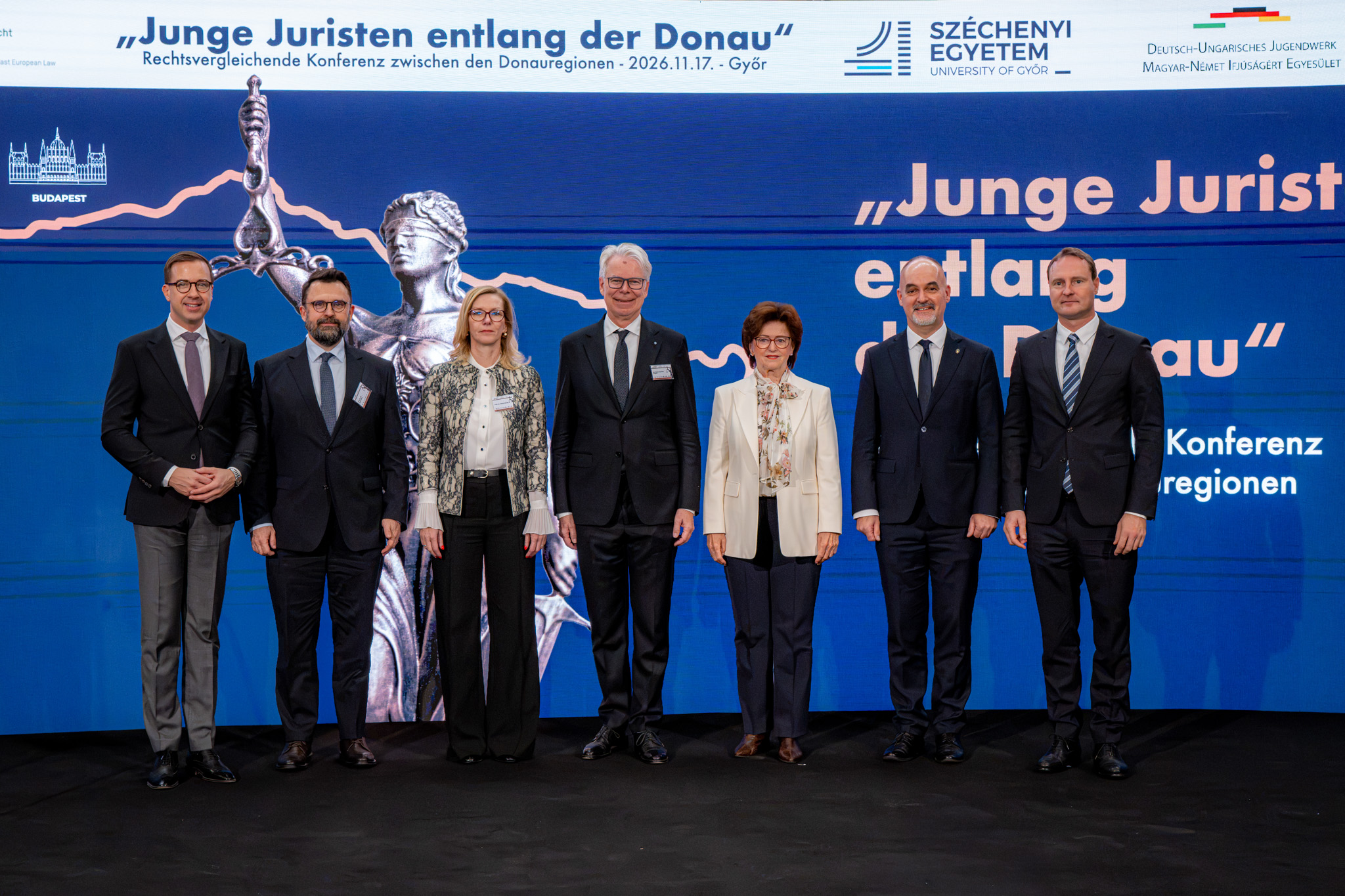
Participants in the conference’s opening programme: Gábor Tordai-Lejkó, Hungary’s Consul General in Munich and Doyen of the Bavarian Consular Corps; Professor Dr Pál Sonnevend, President of the Hungarian Constitutional Court; Dr Márta Görög, Minister of Justice; Dr Hans-Joachim Heßler, President of the Bavarian Constitutional Court; Dr Erzsébet Knáb, President of the Hungarian–German Youth Association and Founding President of the foundation maintaining SZE; Professor Dr Péter Smuk, Dean of the Deák Ferenc Faculty of Law and Political Sciences at SZE; and Dr Bálint Filep, President of SZE. (Photo: András Adorján)
Professor Dr Péter Smuk, Dean of the Deák Ferenc Faculty of Law and Political Sciences at the host university, welcomed the speakers taking part in the academic programme. He recalled that 2026 marks the 250th anniversary of legal education in Győr, as Maria Theresa founded the Royal Academy in the city in 1776. “One of our strategic objectives is to become a visible presence on the international academic stage while also nurturing Hungary’s legal culture. One of the key drivers of our international openness and partnership-building is the German Law Centre at our Faculty. The centre was originally established to organise specialist language courses, but it has since grown far beyond this role. It has developed high-quality professional and academic networks, helping the entire Faculty with international publications, research networks and the organisation of prestigious events such as today’s conference,” he explained. The Dean pointed out that legal education must both preserve the values of Hungary’s legal culture and remain open to European constitutional dialogue.
One of the event’s keynote speakers, Dr Márta Görög, Minister of Justice, who has spent a significant part of her career in higher education, delivered a lecture entitled “A New Era of Hungarian Constitutionalism”. “When we are talking about professional work with young colleagues, talent development or international partnerships, these are always driven by new ideas and the desire to improve existing arrangements. This is where the real strength of such communities and events lies: in horizontal knowledge transfer,” she said. Outlining the Ministry’s objectives, she identified four priority areas: restoring the rule of law and constitutionalism; strengthening the independence and standing of the judiciary; combating corruption; and creating a predictable legal environment that supports economic competitiveness. She explained that high-quality law-making is fundamental to achieving these goals, and that this requires clear objectives, legal certainty and broad-based public consultation.
In his lecture entitled “The Resilience of Democracy: How Far Does the Rule of Law Extend?”, Professor Dr Pál Sonnevend, President of the Hungarian Constitutional Court, examined the importance of safeguarding the rule of law amid the crises of our time. He pointed out that the consistent application of the law is particularly important in times of social division and political tension, as it is the most important safeguard against the arbitrary exercise of power. “One of the Constitutional Court’s important tasks today is to restore public confidence in constitutional justice. This can be achieved if the Constitutional Court, in line with shared European traditions and exercising due restraint, yet always acting firmly, makes its decisions without fear or favour, focusing solely on the relevant constitutional provisions and the legislation or court decision under review,” he explained. He stressed that the long-term functioning of a democratic state governed by the rule of law depends on legal interpretation and the application of the law being guided by consistent professional principles and remaining independent of political interests.
Dr Hans-Joachim Heßler, President of the Bavarian Constitutional Court, spoke about the role of the democratic state governed by the rule of law in times of crisis. He explained that wars, economic uncertainty, technological change and social divisions are collectively testing citizens’ trust in institutions. He stressed that the rule of law provides security precisely in times of crisis. “It binds the actions of the state to the law and legislation, thereby protecting the dignity and freedom of citizens. It ensures that there are checks and opportunities to object. This means that, even in times of crisis, people do not feel at the mercy of events; instead, they remain independent actors, even vis-à-vis the state,” he explained. Among the most important conditions for preserving the democratic system, he identified credible government, an independent judiciary, a free press and an active civil society. He also highlighted the importance of dialogue, arguing that communication based on mutual respect and bridging political, social and cultural differences is essential to the survival of the rule of law.
The morning’s academic presentations were followed by an expert roundtable discussion, moderated by Professor Dr Péter Smuk and featuring Dr Márta Görög, Professor Dr Pál Sonnevend and Dr Hans-Joachim Heßler.
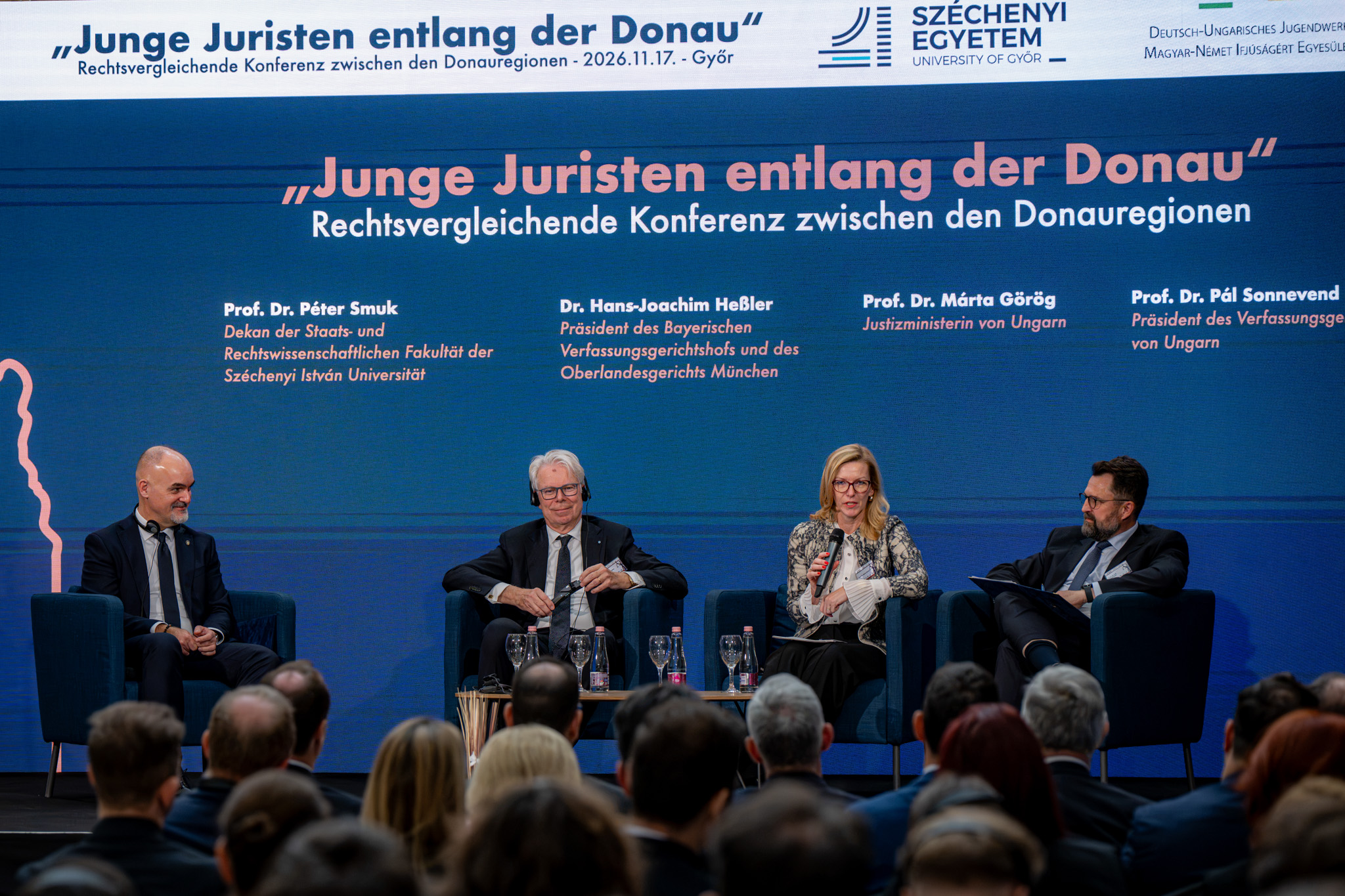
Participants in the roundtable discussion: Professor Dr Péter Smuk, Dean of the Deák Ferenc Faculty of Law and Political Sciences at SZE; Dr Hans-Joachim Heßler, President of the Bavarian Constitutional Court; Dr Márta Görög, Minister of Justice; and Professor Dr Pál Sonnevend, President of the Hungarian Constitutional Court. (Photo: András Adorján)
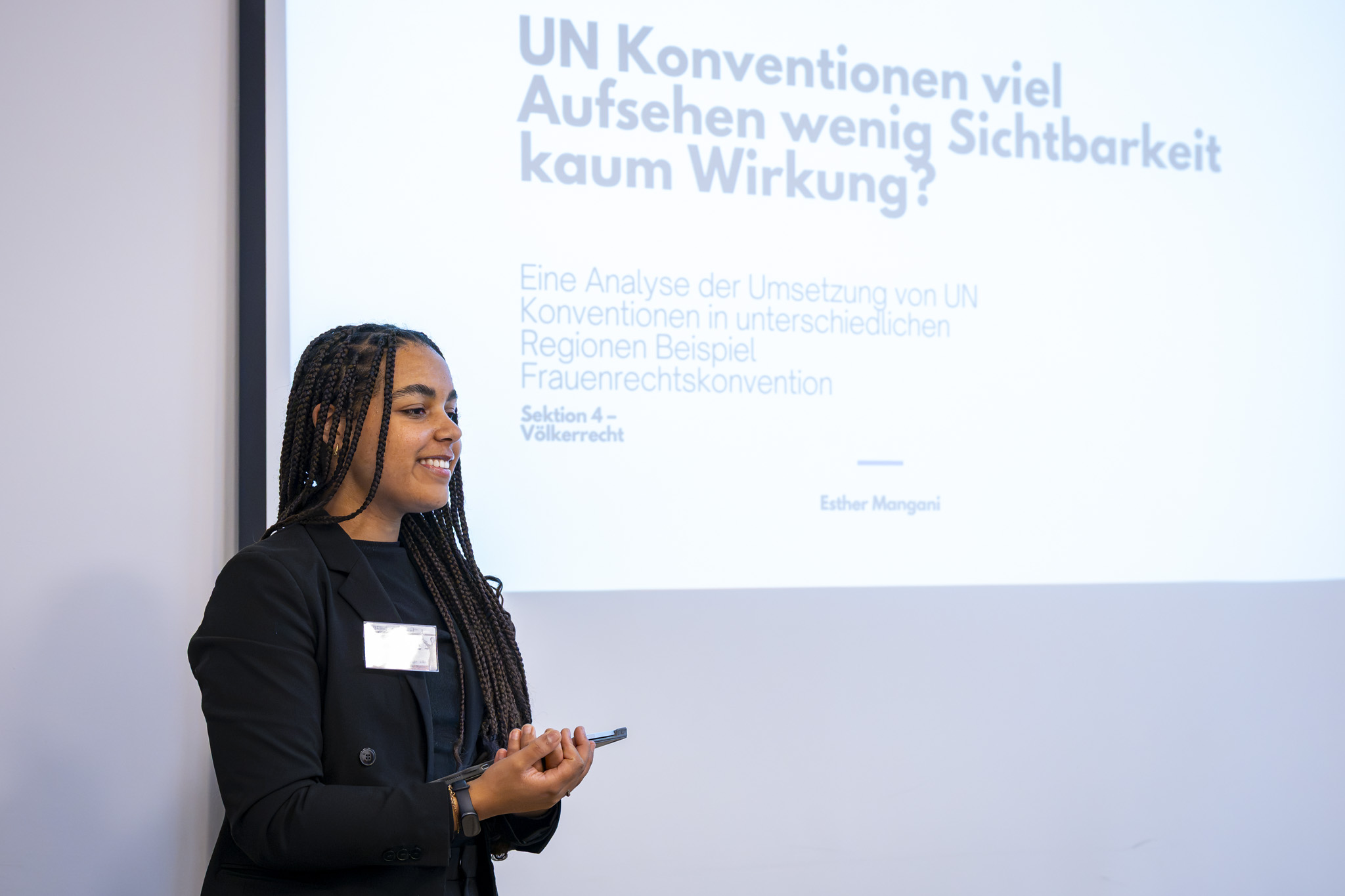
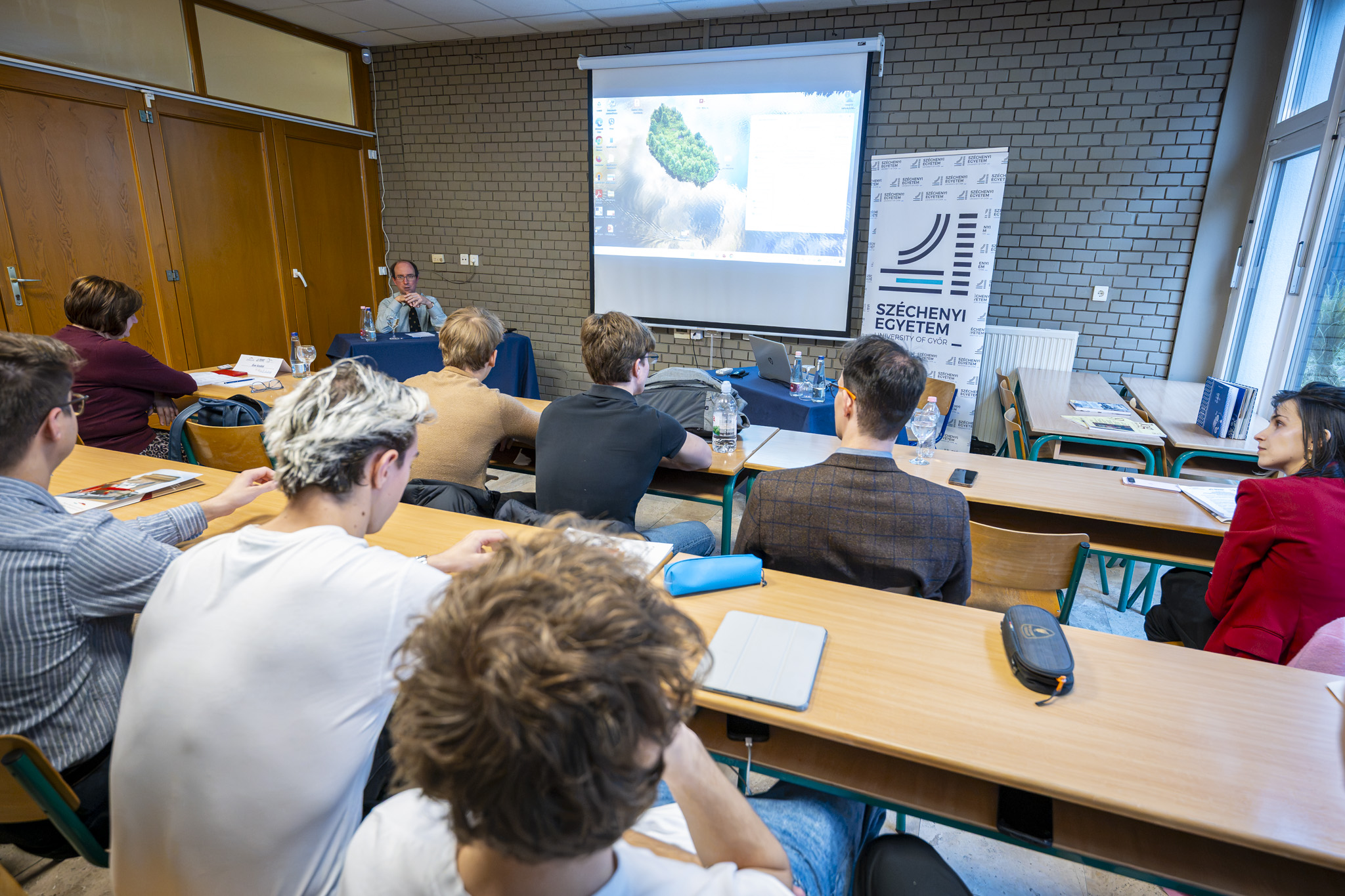
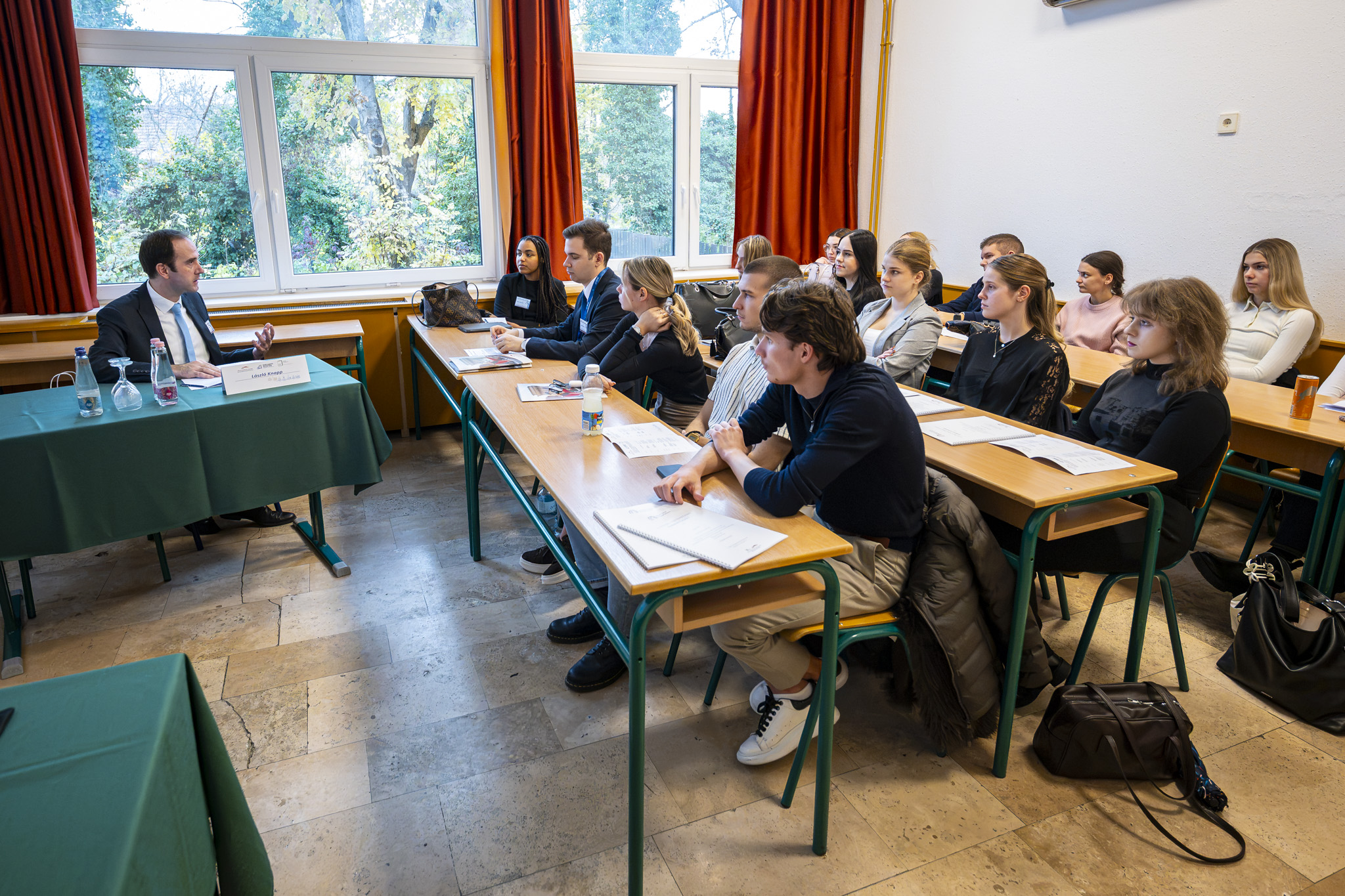
The conference continued with academic discussions among young lawyers. Students and doctoral students from higher education institutions in Hungary, Germany and Austria presented their research in six thematic sessions at the Deák Ferenc Faculty of Law and Political Sciences. Their presentations covered a range of topics, including constitutional cooperation, European private law, the regulation of digital platforms, the implementation of international conventions, the rights of detainees and the protection of minorities. The discussions not only provided an opportunity to share experiences but also helped lay the foundations for long-term academic links between young lawyers from the countries along the Danube.